Prove MN Is Parallel to BD in Tetrahedron ABCD
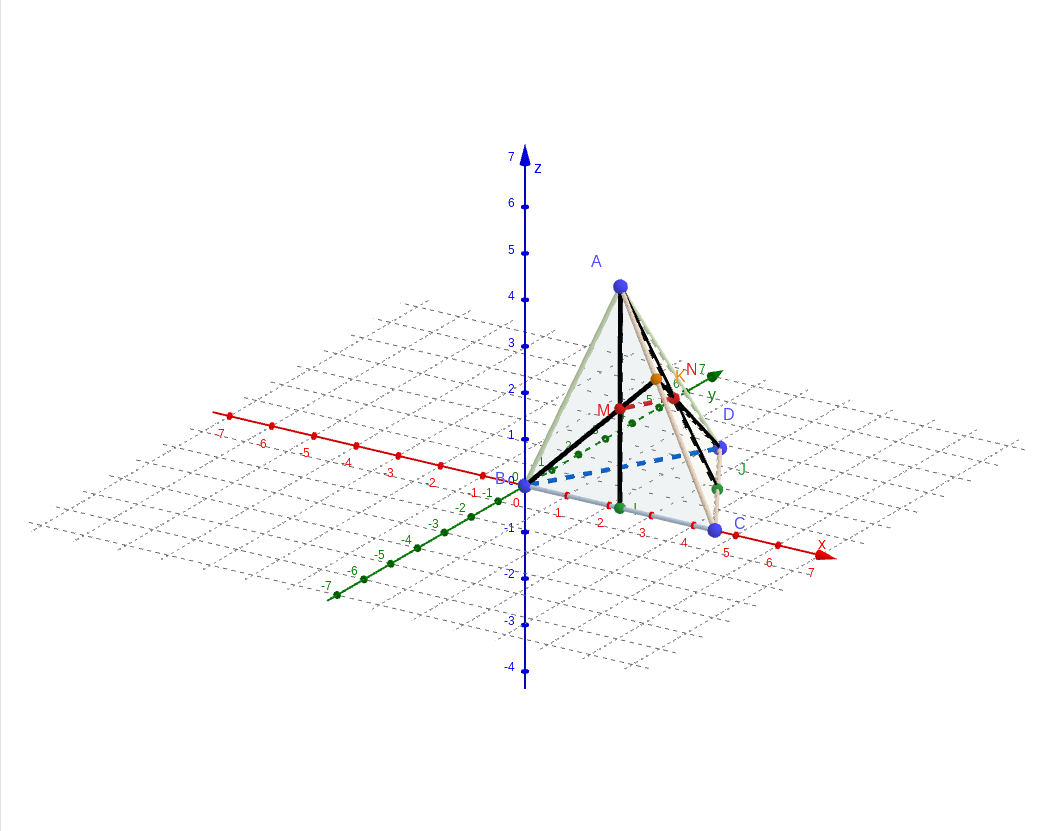
Question: Given tetrahedron ABCD. Let I and J be the midpoints of edges BC and CD, respectively. Let K be a point on edge AC. Let M be the intersection of BK and AI, and let N be the intersection of DK and AJ. Prove that the line MN is parallel to the line BD.
To prove that
, we analyze the plane geometry within the triangular faces
and
, and then apply the converse of the proportional intercept theorem in
.
Geometric Setup and Diagram Elements
- Tetrahedron : The vertices are (top apex), , , and (base).
- Midpoints and : is the midpoint of , and is the midpoint of .
- Point : A point on edge .
- Intersection Points
and
:
- In the plane of , is the intersection of median and line segment .
- In the plane of , is the intersection of median and line segment .
- Lines and : Highlighted in red and blue respectively to demonstrate that they are parallel.
Marking Scheme
(a) ≈ 4 marks
Let
be the midpoint of
.
SolutionMarks
In
,
is the midpoint of
and
is the midpoint of
, so
and
[midpoint thm.].
1M
In
,
, so
[prop. intercept thm.], which yields
.
1
Similarly, in
, with
as the midpoint of
,
and
.
1M
In
, since
,
∴
[converse of prop. intercept thm.].
1