Piecewise Function: Continuity and Differentiability
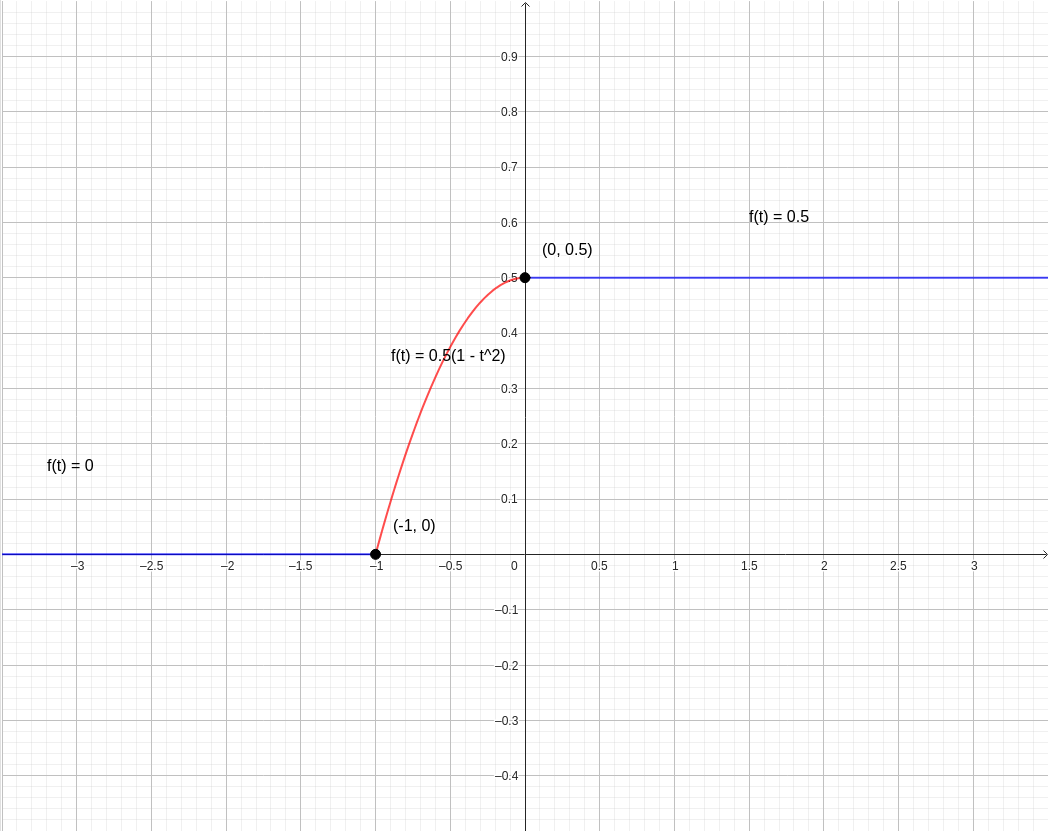
Question: 0 if t < -1 and 1over2 time (1-t^2) for -1<=t<0 and half for t>=0
An analysis and visual breakdown of the piecewise function
is presented below:
1. Piecewise Breakdown
-
Left Branch ( ):
- Equation:
- Shape: A flat horizontal line lying directly on the -axis.
- As : The value approaches .
-
Middle Branch ( ):
- Equation:
- Shape: A downward-opening parabolic arc.
- Start point ( ): .
- End/Peak point ( ): .
- Behavior: Strictly increasing from up to its maximum value of on .
-
Right Branch ( ):
- Equation:
- Shape: A flat horizontal line at a constant height of .
2. Continuity Analysis
To determine if the function is continuous everywhere, we check the transition boundaries:
- At :
Since
, the function is continuous at
.
- At :
Since
, the function is continuous at
.
Therefore,
is continuous for all
.
3. Differentiability and Smoothness
Taking the derivative piecewise:
- At : The left derivative is , while the right derivative is . Because the slopes do not match, there is a sharp corner (non-differentiable) at .
- At : The left derivative approaches , and the right derivative is . Because both slopes match with a value of , the transition is completely smooth (differentiable) at .
4. Summary of Properties
- Domain:
- Range:
- Key Boundary Points: and
Below is the interactive visual representation of
showing the three connected branches.