Perpendicular Chords Circle Problem
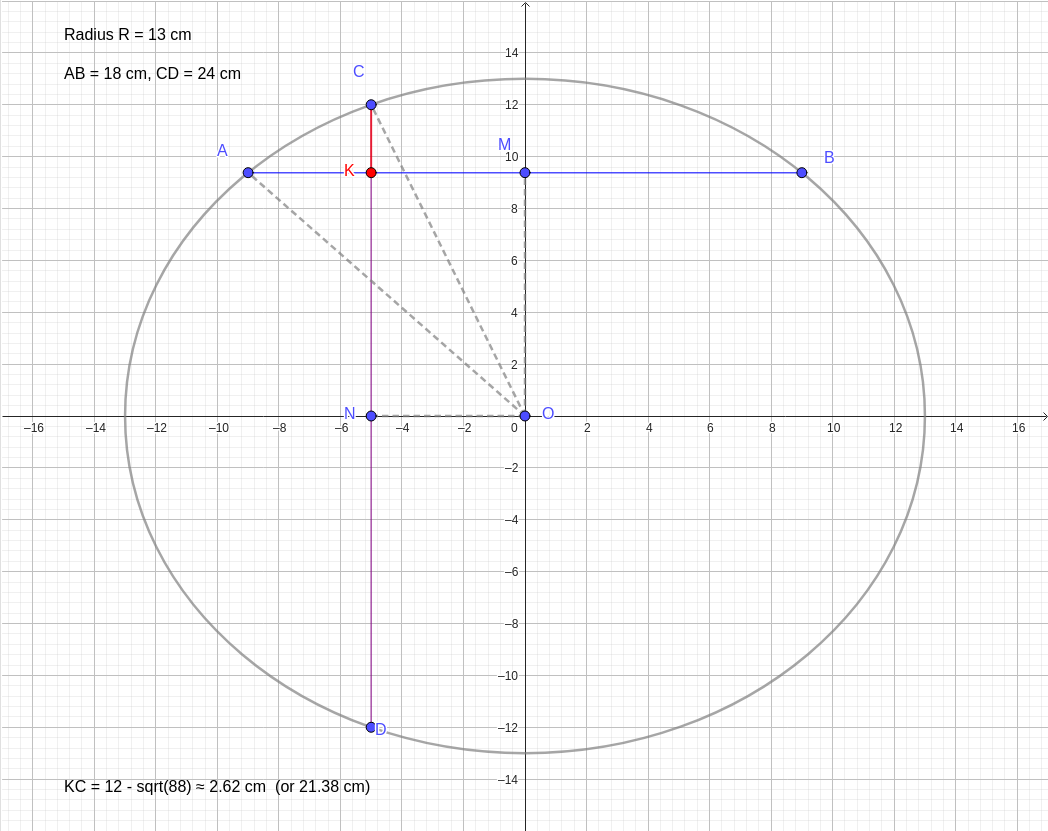
Question: A, B, C and D are lie on a circle. AB and CD are perpendicular chords intersecting at K. AB=18cm, CD=24cm and the radius of the circle is 13 cm. Find the length of KC. (give your answer correct to 2 decimal places.)
To find the length of
, we use the properties of chords, perpendiculars from the circle's center, and the Pythagorean theorem.
Step-by-Step Mathematical Derivation
Let
be the center of the circle with radius
.
1. Distance from the Center to the Chords
-
Let be the midpoint of chord . The perpendicular from the center to any chord bisects the chord: In the right-angled triangle :
-
Let be the midpoint of chord : In the right-angled triangle :
2. Properties of the Quadrilateral
- Since , , and the chords , the quadrilateral has three right angles (at , , and ).
- Therefore, is a rectangle.
- Opposite sides of a rectangle are equal:
3. Calculating the Length of
Point
lies on the chord
, and
is the midpoint of
. Depending on whether
is the nearer or farther endpoint to
:
-
Case 1 (if is the nearer endpoint to ):
-
Case 2 (if is the farther endpoint to ):
Thus, the length of
is
(or
).