Parallel Lines Cut by Two Transversals (Intercept Theorem)
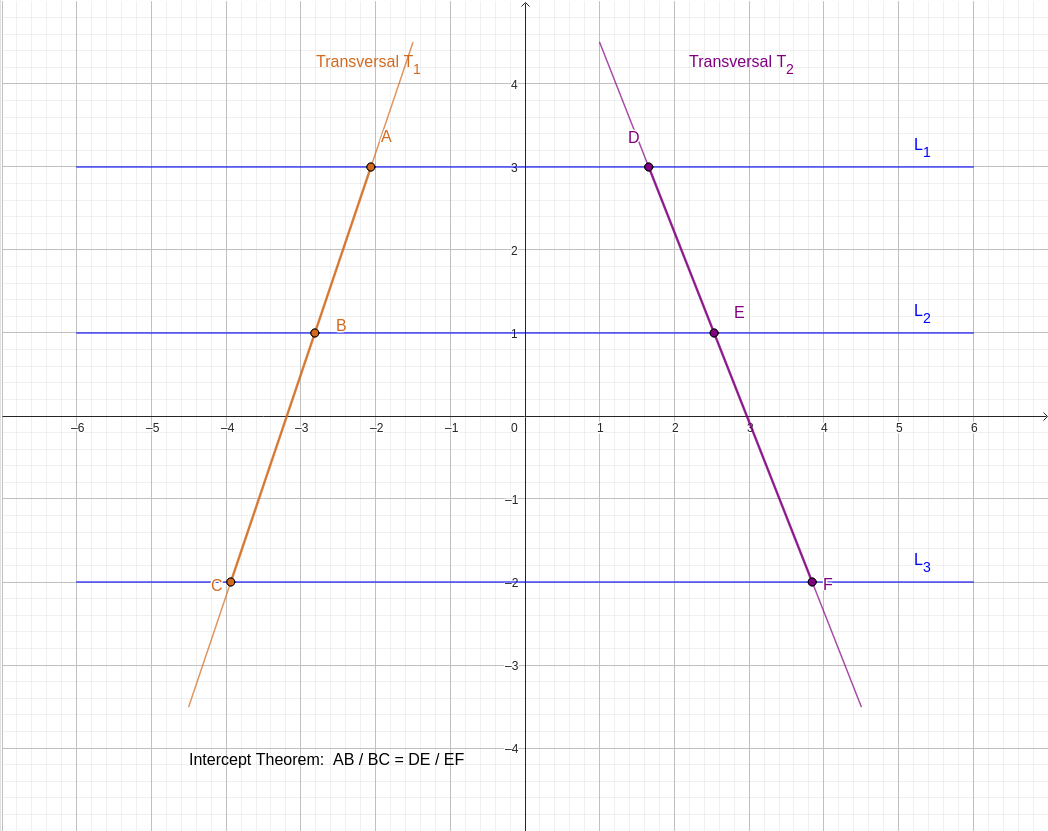
Question: draw parallel lines cut by two non parallel transversals
Geometric Setup & Theorems
When three parallel lines (
) are cut by two non-parallel transversal lines (
and
), two fundamental geometric properties arise:
1. Intercept Theorem (Equal Ratios on Transversals)
Parallel lines cut transversal lines into proportional segments:
2. Similar Triangles
Because the two transversals are not parallel, they intersect at a point
. Since the lines
are parallel:
- is common to all three triangles.
Therefore, by AAA:
This gives the side-length ratios:
Diagram Elements
- Blue Horizontal Lines ( ): The three parallel lines.
- Purple Lines ( ): The two non-parallel transversals meeting at point .
- Points : Intersections of transversal with .
- Points : Intersections of transversal with .
- Slider ( ): Adjusts the position of the middle parallel line to dynamically demonstrate that the ratio always remains equal to .