Parallel Lines Corresponding Angles
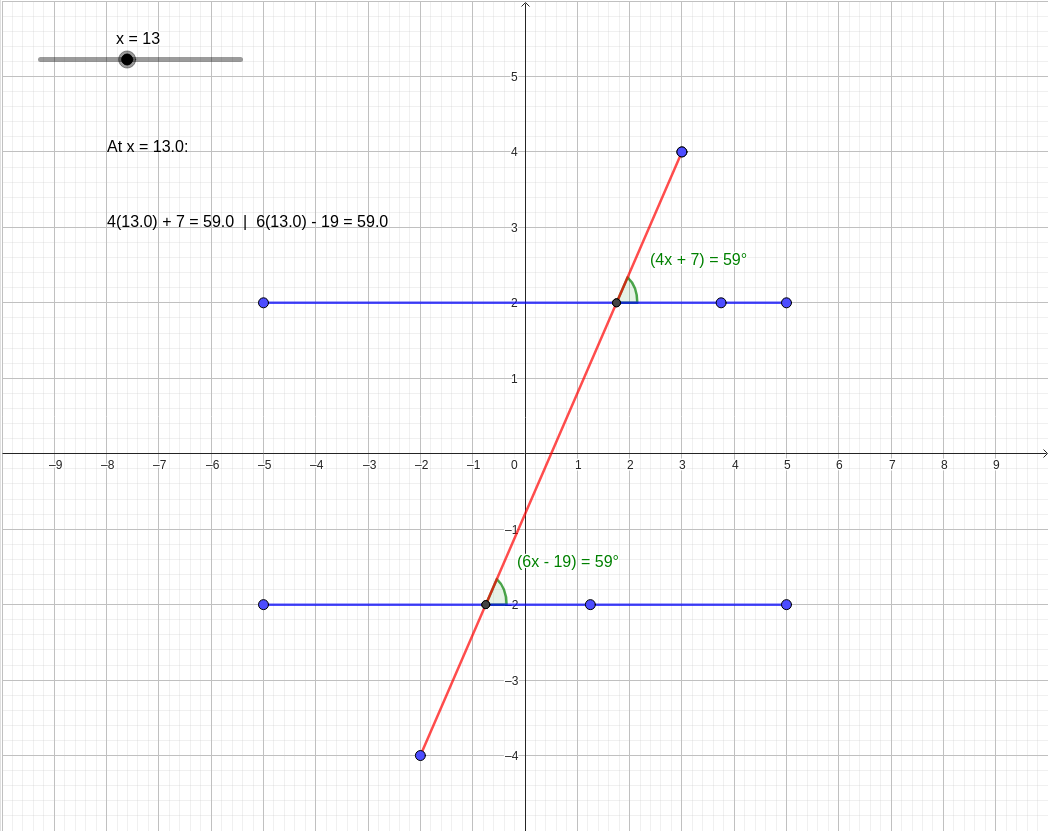
Question: Two lane-edge lines are parallel and a service road crosses them. Corresponding angles are labeled (4x + 7)° and (6x - 19)°
When two parallel lines (the lane-edge lines) are crossed by a third line (the service road, or transversal), the angles created at each intersection have specific geometric relationships.
Geometric Principle
The problem identifies these as corresponding angles. By definition, corresponding angles occupy the same relative position at each intersection where a transversal crosses two parallel lines.
The Corresponding Angles Postulate states that if two parallel lines are cut by a transversal, then the pairs of corresponding angles are congruent (equal in measure).
Algebraic Solution
Since the lines are parallel, we set the two expressions equal to each other:
Finding the Angle Measure
To find the actual measure of the angles, substitute
back into either expression:
Both angles measure
, confirming they are congruent as expected for parallel lines.
Visual Representation
In the diagram:
- The blue lines represent the parallel lane-edge lines.
- The red line represents the service road acting as the transversal.
- The highlighted angles show the corresponding positions. Notice that as you move the slider for , the values of the two expressions change, but they are only equal (making the geometry consistent with parallel lines) when reaches .