Orthocentre and Circumcentre Angle Problem
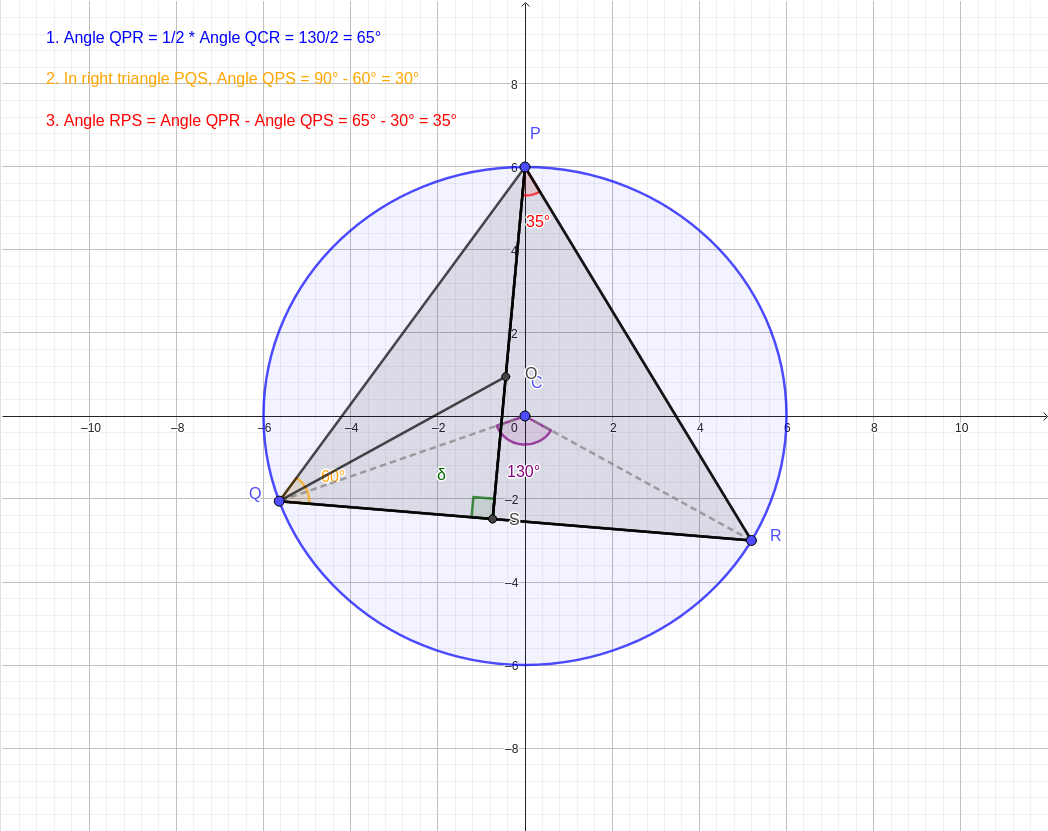
Question: O and C are respectively the ortho-centre and circum-centre of an acute-angled triangle PQR. The points P and O are joined and produced to meet the side QR at S. If ∠PQS = 60° and ∠QCR = 130°, then ∠RPS = (1) 30° (2) 35° (3) 100° (4) 60° make it easy
To find the value of
, we can use the geometric properties of the orthocentre, the circumcentre, and the relationships between angles in a circle.
1. The Altitude Property
The orthocentre (
) is the intersection of the altitudes of a triangle. The problem states that the line joining
and
is produced to meet the side
at
. Since an altitude is a line from a vertex perpendicular to the opposite side,
must be the altitude from vertex
to side
.
Therefore:
2. Finding
Now, consider the right-angled triangle
. We are given that
. Using the fact that the sum of angles in a triangle is
:
3. The Circumcentre Theorem
The circumcentre (
) is the center of the circle passing through all three vertices (
). According to the circle theorem, the angle subtended by an arc at the center is twice the angle subtended by it at any point on the remaining part of the circumference.
Given that the central angle
, the angle at the circumference
is:
4. Calculating
The total angle at vertex
, which is
, is composed of two adjacent angles:
and
.
Substituting the values we found:
The correct answer is (2) 35°.