Monomorphism Injective Equivalence Proof
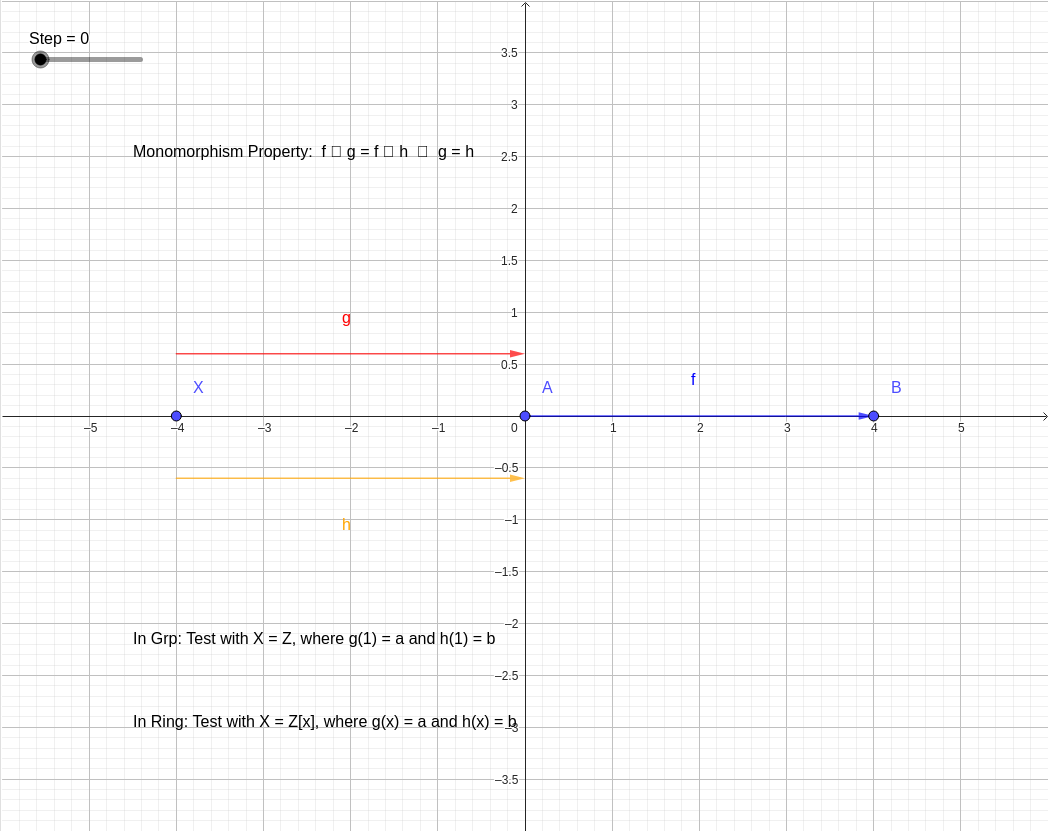
Question: In the group or ring categories, how to prove monomorphism is equivalence to injective
To prove that a morphism is a monomorphism if and only if it is injective in the category of groups (
) and the category of rings (
), we recall the foundational definitions and then establish both directions.
1. Definitions
-
Injective Homomorphism: A map is injective if . For groups and rings, this is equivalent to containing only the identity / zero element:
-
Monomorphism (Categorical): A morphism is a monomorphism (or monic) if it is left-cancellable: for any object and any pair of parallel morphisms ,
2. Direction 1: Injective Monomorphism (General Case)
This direction holds in any concrete category where morphisms are underlying set maps.
Let
be an injective homomorphism. Suppose
is an arbitrary object and
are two homomorphisms such that:
For any element
:
Since
is injective:
Therefore, as functions on underlying sets,
. Hence,
is a monomorphism.
3. Direction 2: Monomorphism Injective
To show that a monomorphism must be injective, we strategically construct a test object
and two distinct maps
if
were non-trivial, leading to a contradiction.
Case A: In the Category of Groups ( )
Let
be a monomorphism of groups. Suppose for contradiction that
is not injective, so there exists some element
with
such that
.
-
Choose the test group (the free group on one generator).
-
Define two group homomorphisms completely determined by where they send the generator :
-
Compose each with :
Thus,
. Since
is a monomorphism, this implies
. Evaluating at
:
which contradicts our assumption that
. Thus,
, proving that
is injective.
(Alternative proof: Take
, with
being the natural inclusion and
being the trivial homomorphism. Then
.)
Case B: In the Category of Rings ( )
Let
be a monomorphism of unital rings. Suppose for contradiction that
is not injective, so there exists some
with
such that
.
-
Choose the test ring (the polynomial ring over , which is the free ring on one generator ).
-
By the universal property of polynomial rings, a ring homomorphism from to is uniquely determined by the choice of image for .
-
Define two ring homomorphisms :
-
Compose each with on any polynomial :
Thus,
for all
, meaning
. Since
is monic, it follows that
. Evaluating at
:
which contradicts
. Thus,
, proving that
is injective.
Summary
In both
and
:
- Injective Monic follows from pointwise equality of maps.
- Monic Injective follows from testing against the free object on one generator ( for groups, for rings) to isolate any non-zero element in the kernel.