Linear Transformation Eigenvectors Unit Square
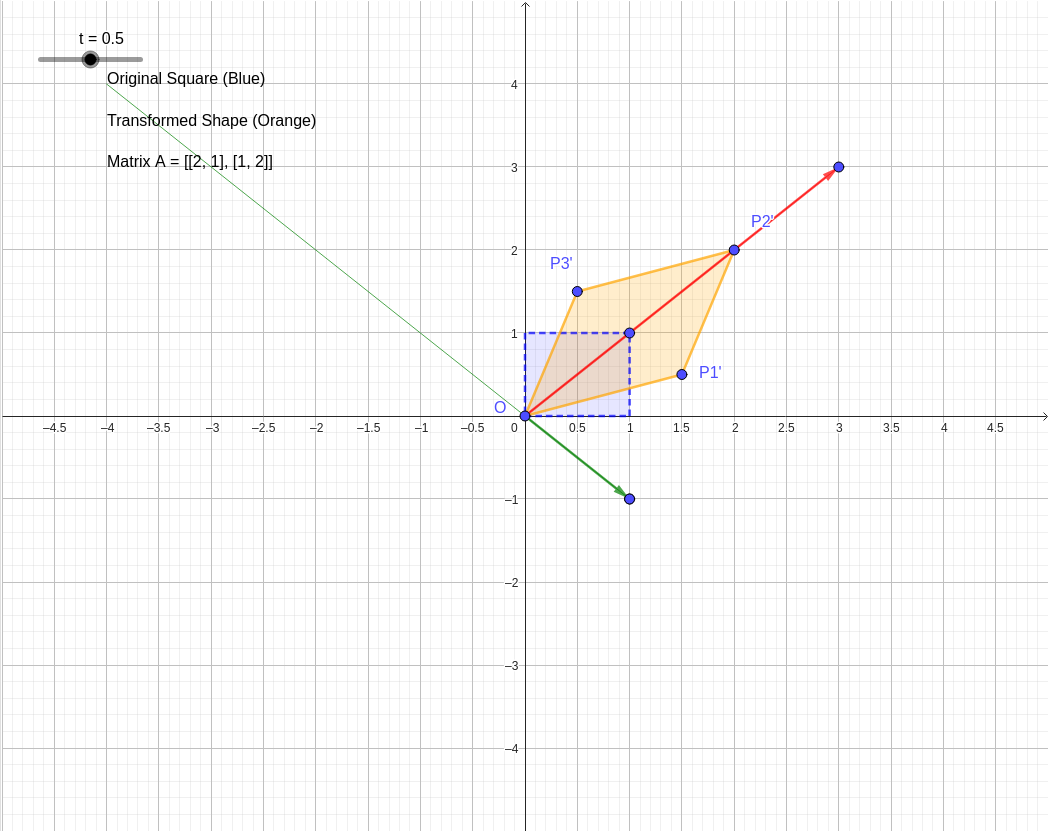
Question: Graph a 2D linear transformation matrix \(A = \begin{pmatrix} 2 & 1 \\ 1 & 2 \end{pmatrix}\) acting on a unit square, and plot its eigenvectors.
A linear transformation can be thought of as a function that takes a vector in 2D space and maps it to a new location, while keeping the origin fixed and keeping straight lines straight and parallel. The matrix
describes how the basis vectors
and
are transformed.
The Transformation of the Unit Square
The unit square is defined by four vertices:
,
,
, and
. When the matrix
acts on these points, they are mapped to:
- : (The origin remains fixed).
- : (The first column of ).
- : (The sum of the columns).
- : (The second column of ).
The original blue unit square is transformed into an orange parallelogram. Notice how the shape is stretched and tilted.
Eigenvectors and Eigenvalues
Eigenvectors are special directions in space that do not change their orientation during the transformation; they are only scaled (stretched or compressed). For this matrix, there are two distinct eigenvector directions:
- Primary Eigenvector (
): This lies along the line
(shown in red).
- Its eigenvalue is .
- Geometrically, any point on this line is moved three times further from the origin in the same direction. Notice that the vertex of the original square lies on this line and is mapped to .
- Secondary Eigenvector (
): This lies along the line
(shown in green).
- Its eigenvalue is .
- A scaling factor of 1 means that any point along this line stays exactly where it is. This is why the transformation appears to "expand" away from the axis while staying anchored along it.
In the interactive diagram below, use the slider t to see the transformation transition from the identity (the original square) to the final transformed state.