Two Isosceles Triangles on a Common Base: Same or Opposite Sides?
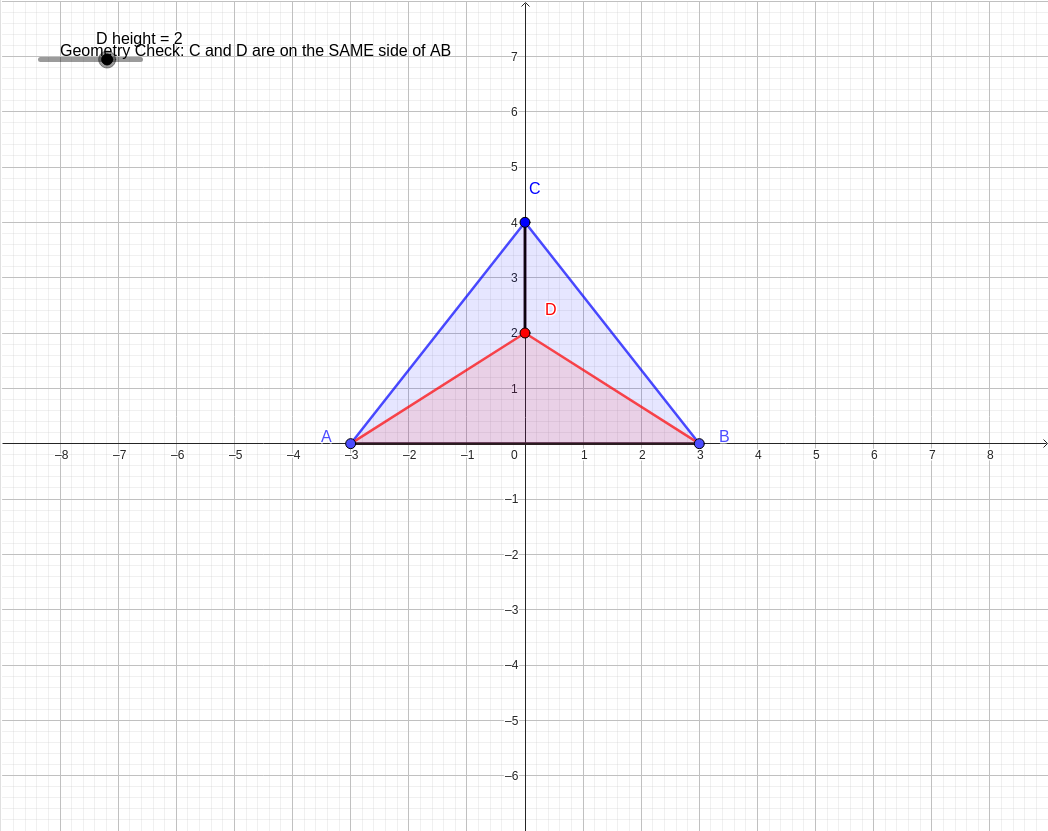
Question: Is this true? Given two isos triangles abc,abd with |ca|=|cb|, |da|=|db|, then a b diffside cd and c d diffside ab.
The statement is False.
To understand why, we must look at the geometric properties of isosceles triangles that share a common base.
1. The Perpendicular Bisector Property
In any isosceles triangle, the vertex opposite the base must lie on the perpendicular bisector of that base.
- Since is isosceles with , point must lie on the perpendicular bisector of segment .
- Since is isosceles with , point must also lie on the perpendicular bisector of segment .
Because both
and
lie on the perpendicular bisector of
, the line passing through
and
(line
) is the perpendicular bisector of
.
2. Analyzing the "Different Sides" Claims
The claim consists of two parts:
- and are on different sides of line : This is always true. Since is the perpendicular bisector of , it passes through the midpoint of and is perpendicular to it. Therefore, and must lie in the two different half-planes created by line .
-
and
are on different sides of line
: This is not necessarily true. While we know
and
both lie on the perpendicular bisector, there is no rule stating they must be on opposite sides of the base
.
- If and are on opposite sides, the quadrilateral forms a convex kite.
- If and are on the same side of (for example, if is "nested" inside ), they are on the same side of line . This forms a non-convex (dart-shaped) kite.
3. Conclusion
Because the second part of the condition ("
and
on different sides of
") can be false, the overall statement is not a universal truth in geometry.
In the provided interactive diagram:
- Points A and B define the common base.
- Point C is fixed on the perpendicular bisector.
- You can move the slider to change the position of Point D along the perpendicular bisector.
- Observe that when the slider is positive, and are on the same side of the dashed line , proving the statement is false.