Is D Same As C
Question: Given C on segment AB and a point D, If AC=AD, CB=DB, then is D necessarily the same point as C
To determine whether point
must be the same as point
, we can use the properties of line segments and the Triangle Inequality.
Geometric Reasoning
-
Collinearity of : We are given that point lies on the segment . By the definition of a line segment, the distance from to plus the distance from to must equal the total length of the segment :
-
The Given Conditions: We are told that there is a point such that:
-
The Triangle Inequality: For any three points , and in space, the sum of the lengths of any two sides of the triangle must be greater than or equal to the length of the third side: The equality holds if and only if point lies on the line segment .
-
Substitution: Substitute the equalities from step 2 into the triangle inequality: From step 1, we already know that . Therefore, for point , the inequality becomes an equality:
-
Conclusion: Since , point must lie on the segment . On any line segment , there is exactly one point at a specific distance from point (where ). Since and both points lie on the same segment starting from , and must be the same point.
Visualizing the Constraints
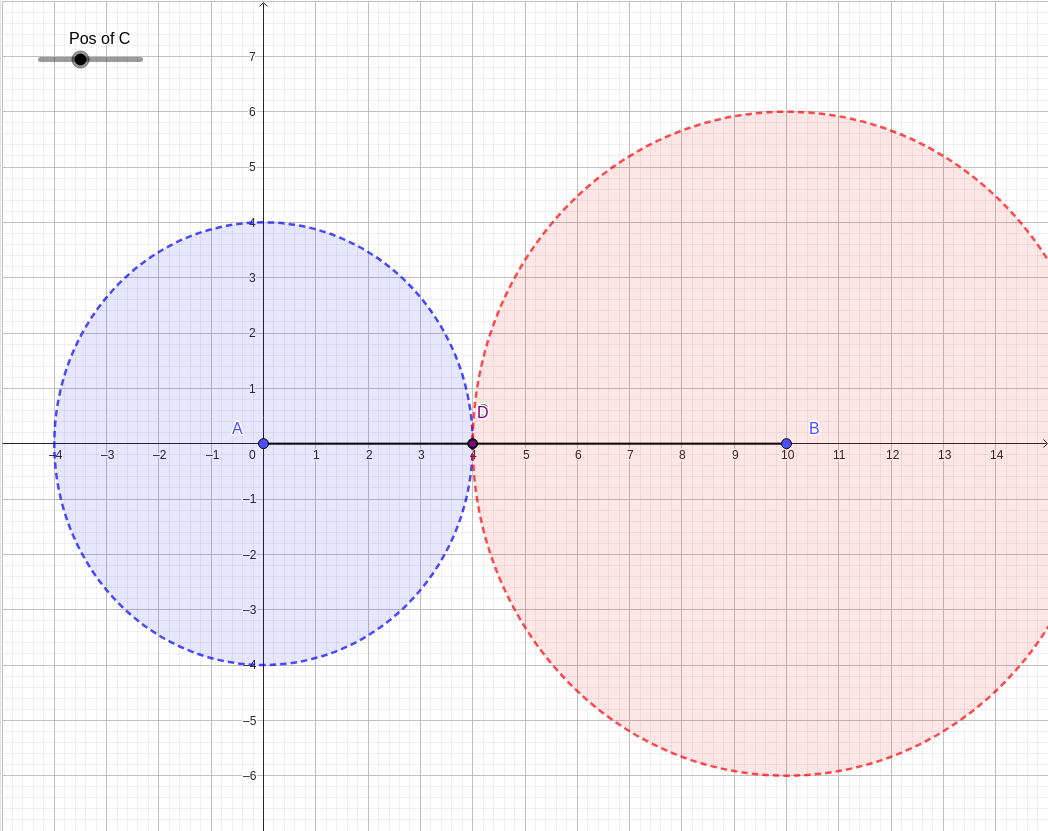
In the diagram below, you can see two circles. The blue circle represents all possible locations for point
such that
. The red circle represents all possible locations for
such that
.
Because
lies on the segment
, these two circles are tangent to each other at exactly one point: point
. There is no other location in 2D or 3D space where a point can satisfy both distance requirements simultaneously.
- Use the slider to move point along the segment.
- Observe that as long as is on the segment, the two circles only touch at that single point.
Yes,
is necessarily the same point as
.