Implicit Differentiation Explained with Examples
Question: Discuss, explain and show examples of implicit differentiation from basics to moderate advanced
Implicit differentiation is a powerful technique used to find the derivative of a variable
with respect to
when
is not isolated on one side of the equation.
1. Explicit vs. Implicit Functions
In most introductory calculus, we deal with explicit functions, where the dependent variable is solved in terms of the independent variable:
Examples:
or
.
However, many geometric shapes and physical relationships are defined by implicit relations, where
and
are mixed together:
(A circle)
(Folium of Descartes)
To find the slope (
) of such curves, we do not need to solve for
. Instead, we differentiate both sides of the equation with respect to
, treating
as a function of
.
2. The Power of the Chain Rule
The core of implicit differentiation is the Chain Rule. Since
depends on
, any term involving
must be differentiated using the logic:
Common patterns include:
3. Step-by-Step Example: The Circle
Consider the circle
. We want to find the slope of the tangent line at any point
on the curve.
Step 1: Differentiate both sides with respect to
.
Step 2: Apply derivative rules.
Step 3: Solve for
.
This result tells us that the slope of a circle depends on both the
and
coordinates. For example, at
, the slope is
. At
, the denominator is zero, correctly indicating a vertical tangent line.
4. Moderate Example: Mixed Terms
Find
for the curve
.
Step 1: Differentiate term by term.
Step 2: Use the Product Rule on
.
Step 3: Factor out
.
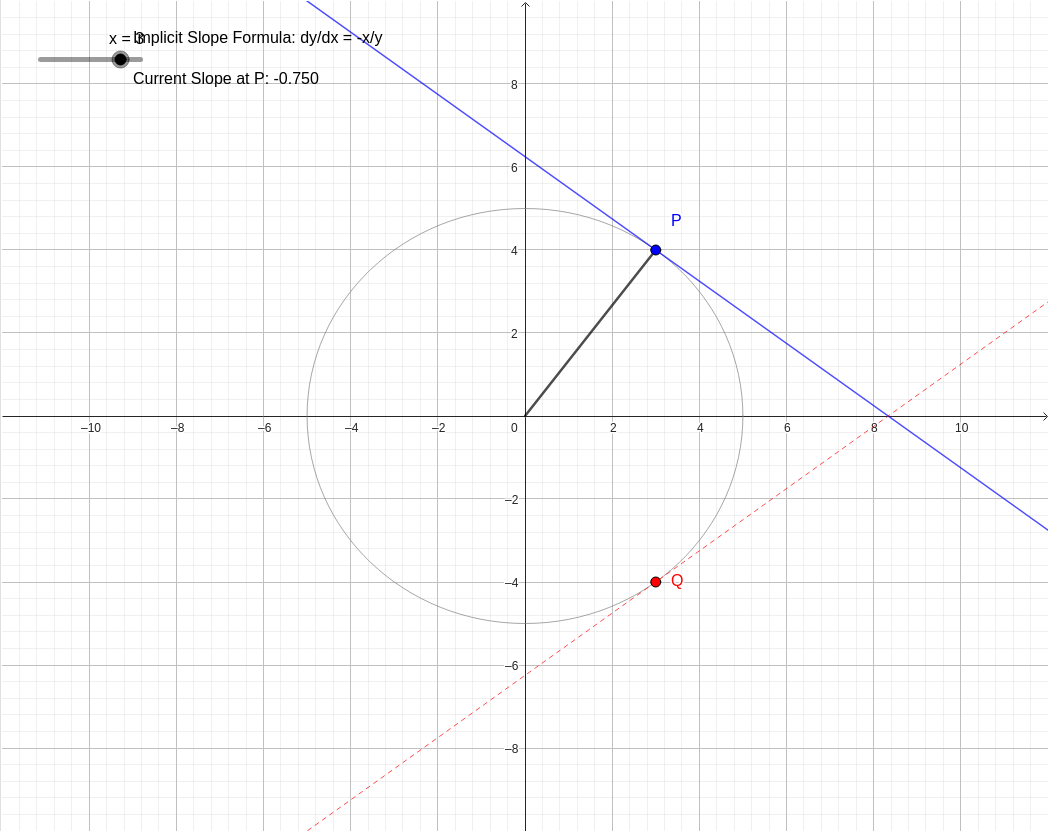
Visualizing Implicit Slopes
In the diagram below, you can see a circle defined by
.
- The point moves along the curve.
- The blue line represents the tangent at that point.
- The value of the slope is calculated using our implicit formula .
- Notice how the slope changes dynamically: it is zero at the top/bottom and undefined at the far left/right .