Brace Splits a Right Angle: Solve (2x+4) and (4x+8)
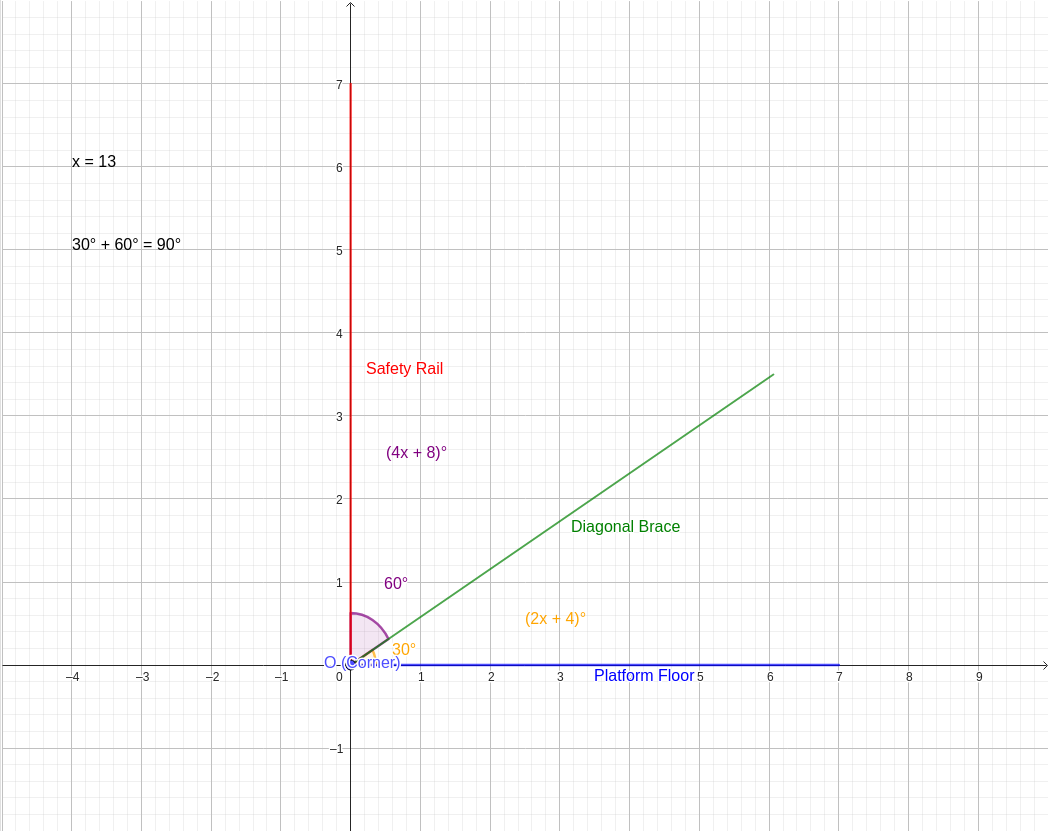
Question: A safety rail is perpendicular to the platform floor. A diagonal brace divides one right angle into two adjacent angles. The smaller angle is (2x + 4)° and the larger angle is (4x + 8)°.
To find the value of
and the measures of the angles created by the safety rail and the floor, we use the geometric principle of complementary angles.
1. Understanding the Geometric Relationship
A safety rail is perpendicular to the platform floor, which means the angle between them is exactly
. When a diagonal brace divides this right angle into two adjacent angles, the sum of those two smaller angles must equal the total
angle.
In the diagram:
- The Platform Floor is represented by the blue horizontal line.
- The Safety Rail is represented by the red vertical line.
- The Diagonal Brace is represented by the green diagonal line.
2. Setting Up the Equation
We are given the expressions for the two adjacent angles:
- Smaller angle:
- Larger angle:
Since they combine to form a right angle, we write the following equation:
3. Solving for x
Now, we solve for the variable
:
4. Calculating the Angle Measures
Substitute
back into the original expressions to find the actual size of each angle:
-
Smaller Angle:
-
Larger Angle:
Summary
The value of
is 13. The two adjacent angles formed by the brace are
and
. You can see in the visual representation that the green brace splits the
corner into these two specific parts.