Greatest k for a Sum of Logarithms of G.S. Terms
Interactive Greatest k for a Sum of Logarithms of G.S. Terms graph — click to explore
Click the graph to explore it interactively →
Question: given A_n is n term of G.S, if a_7 =27 and a_10 =81, find the greatest values of k is log(a_1,a_2) + log(a_2,a_3) + .... + log(a_k,a_k+1)< 5
An interpretation of the notation \log(a_n, a_{n+1}) is the logarithm with base a_n of a_{n+1}, which is denoted as \log_{a_n}(a_{n+1}).

HKDSE Marking Scheme

(a) ≈ 5 marks
SolutionMarks
Let a_1 and r be the first term and the common ratio of the geometric sequence respectively.
r^3 = \frac{a_{10}}{a_7} = \frac{81}{27} = 3 \implies r = 3^{1/3}
1M
a_1 = \frac{a_7}{r^6} = \frac{27}{\left(3^{1/3}\right)^6} = \frac{27}{3^2} = 3
1A
The general term is a_n = a_1 r^{n-1} = 3 \cdot \left(3^{1/3}\right)^{n-1} = 3^{\frac{n+2}{3}}
By change of base formula, \log_{a_n}(a_{n+1}) = \frac{\log_3(a_{n+1})}{\log_3(a_n)} = \frac{\frac{n+3}{3}}{\frac{n+2}{3}} = \frac{n+3}{n+2}
1M
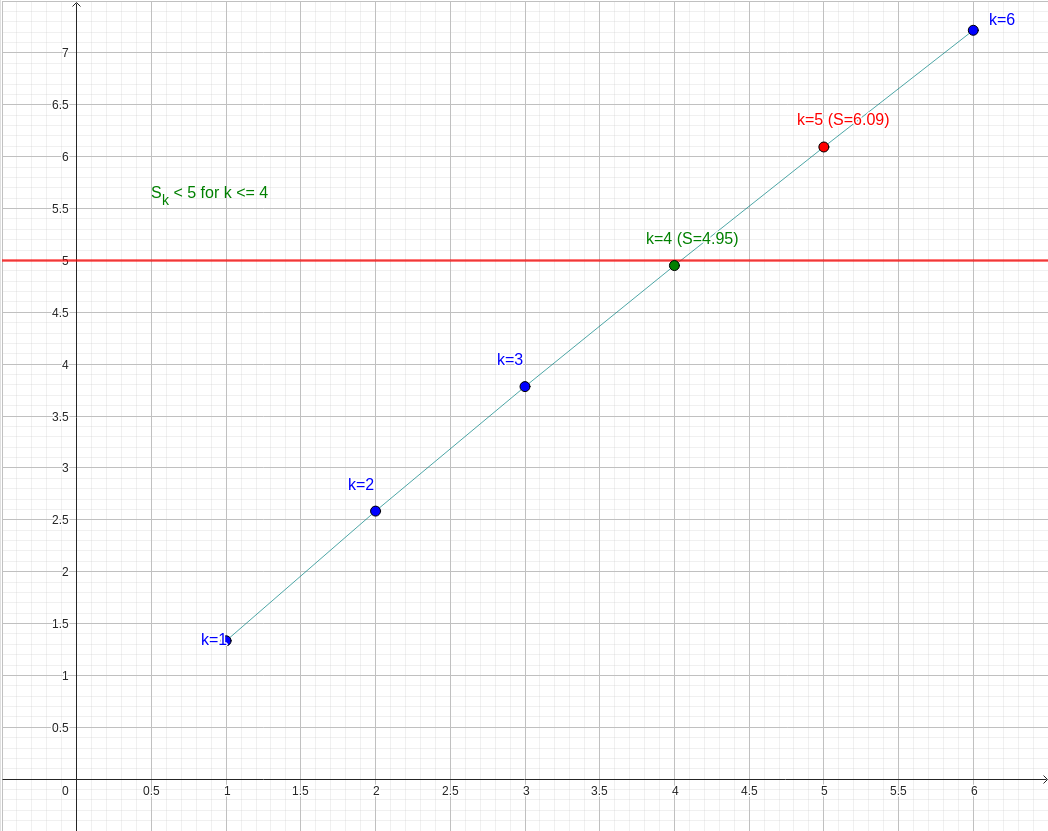
For k = 4, \sum_{n=1}^{4} \log_{a_n}(a_{n+1}) = \frac{4}{3} + \frac{5}{4} + \frac{6}{5} + \frac{7}{6} = \frac{99}{20} = 4.95 < 5
1M
For k = 5, \sum_{n=1}^{5} \log_{a_n}(a_{n+1}) = 4.95 + \frac{8}{7} \approx 6.09 > 5
∴ The greatest value of k is 4.
1A

Visual Explanation

The diagram plots the partial sum S_k = \sum_{n=1}^k \log_{a_n}(a_{n+1}) against k:
  • The dashed red line represents the boundary value y = 5.
  • For k = 1, 2, 3, 4, the sum S_k remains strictly below the threshold line ( S_4 = 4.95 < 5).
  • At k = 5, the sum exceeds 5 ( S_5 \approx 6.09 > 5), making k = 4 the maximum valid integer.