Triangle Angle Bisector and the Angle Bisector Theorem
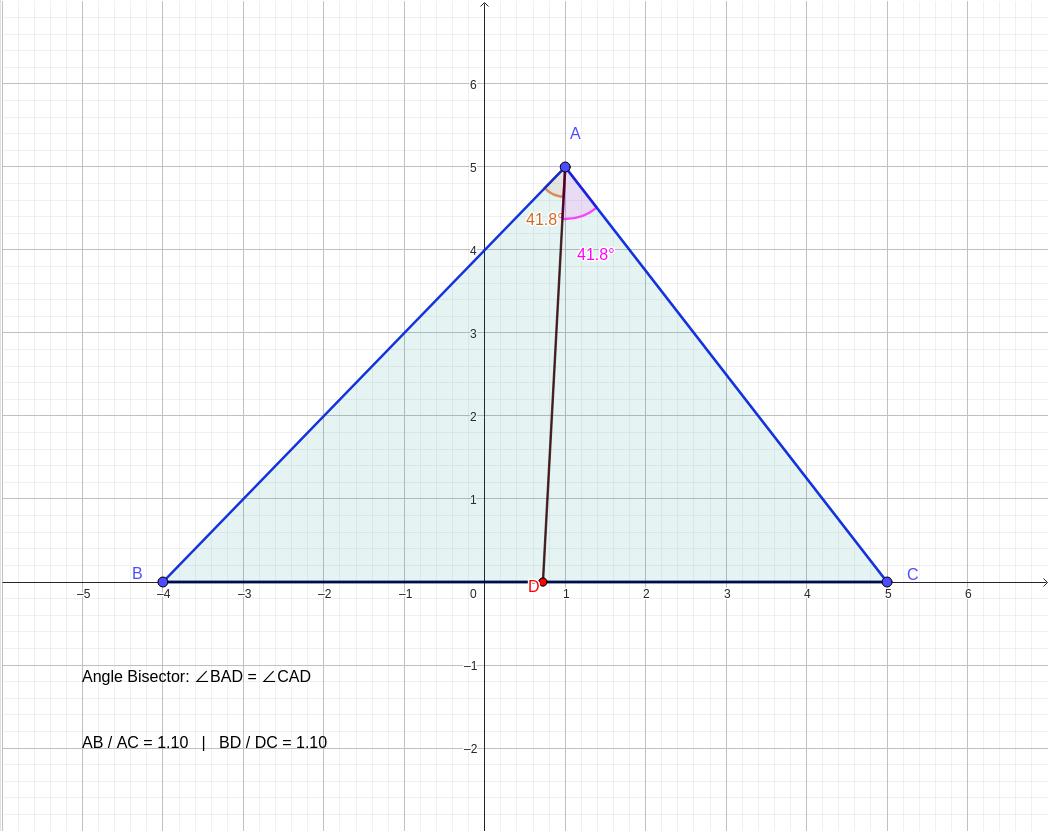
Question: draw me a triangkle with angular bisector
Angle Bisectors in Triangles
An angle bisector of a triangle is a line segment or ray that divides one of the triangle's interior angles into two congruent (equal) angles, extending from the vertex to the opposite side.
Key Properties & Theorems
- Equal Subdivided Angles: If the line segment is the angle bisector of , it splits the angle equally:
- Angle Bisector Theorem: The internal bisector of an angle of a triangle divides the opposite side internally in the ratio of the sides containing the angle:
- Incentre ( ): The internal angle bisectors of all three angles of any triangle are concurrent (they all meet at a single point called the incentre ). The incentre is equidistant from all three sides and serves as the centre of the incircle (inscribed circle).
Diagram Overview
- (shaded in light blue): A general triangle with vertices , , and .
- Line Segment (red): The angle bisector of , meeting the opposite side at point .
- Angle Arcs at Vertex (orange and magenta): The two equal sub-angles and , demonstrating that the bisector divides the vertex angle into two equal parts.
- Ratio Comparison: Shows the proportional relationship on the side lengths.