Circumcircle of Triangle A(0,0), B(12,0), C(3,2)
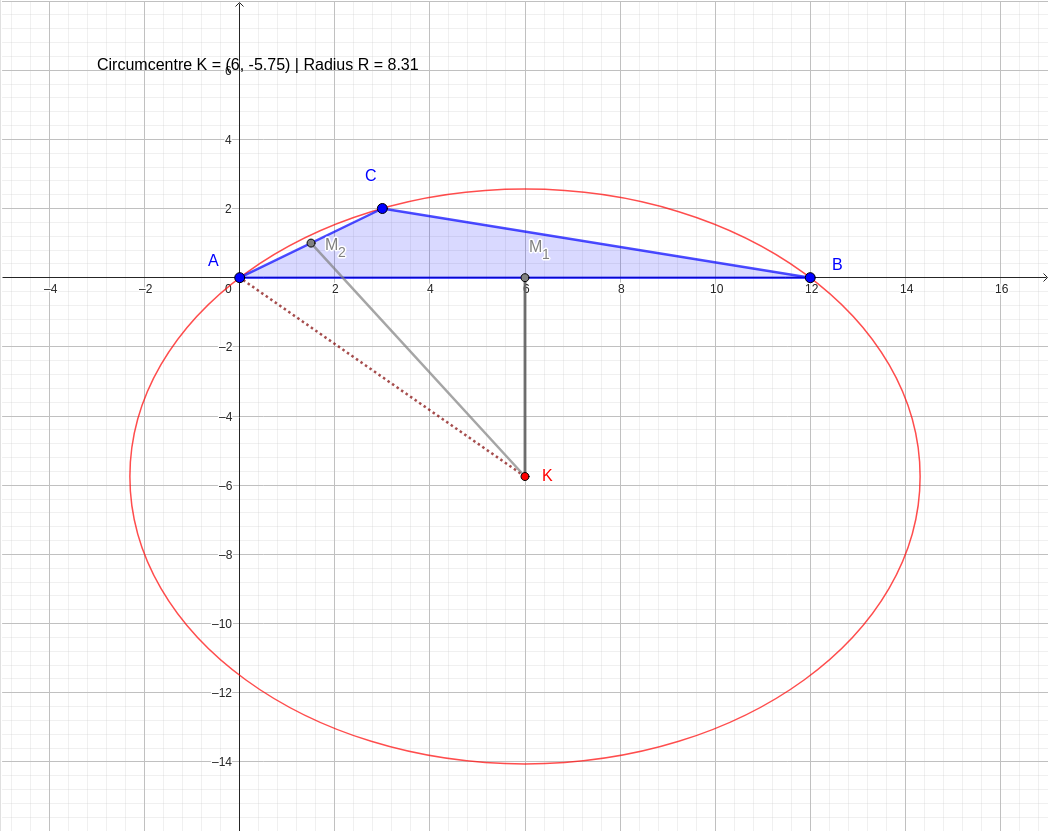
Interactive Circumcircle of Triangle A(0,0), B(12,0), C(3,2) graph — click to explore
Click the graph to explore it interactively →
Question: Draw triangle ABC with A(0,0), B(12,0), C(3,2) and draw its circumcircle.
To construct the circumcircle of \triangle ABC with vertices A(0,0), B(12,0), and C(3,2), we determine its circumcentre and radius using the perpendicular bisectors of the sides.

Mathematical Derivation

1. Finding the Perpendicular Bisector of AB
  • Midpoint of AB:
\left(\frac{0 + 12}{2}, \frac{0 + 0}{2}\right) = (6, 0)
  • Since AB lies horizontally along the x-axis ( y = 0), its perpendicular bisector is the vertical line:
L_1: x = 6

2. Finding the Perpendicular Bisector of AC
  • Midpoint of AC:
\left(\frac{0 + 3}{2}, \frac{0 + 2}{2}\right) = (1.5, 1)
  • Slope of AC:
m_{AC} = \frac{2 - 0}{3 - 0} = \frac{2}{3}
  • Slope of the perpendicular bisector L_2:
m_{\perp} = -\frac{1}{m_{AC}} = -\frac{3}{2}
  • Equation of L_2:
\begin{align*} y - 1 &= -\frac{3}{2}(x - 1.5) \\ y &= -\frac{3}{2}x + \frac{9}{4} + 1 \\ y &= -\frac{3}{2}x + \frac{13}{4} \end{align*}

3. Circumcentre K(h, k) and Radius R
  • Substituting x = 6 into the equation of L_2:
\begin{align*} k &= -\frac{3}{2}(6) + \frac{13}{4} \\ k &= -9 + 3.25 = -5.75 = -\frac{23}{4} \end{align*}
  • The circumcentre is K\left(6, -\frac{23}{4}\right) = (6, -5.75).
  • The radius R is the distance from K to any vertex (e.g., A(0,0)):
\begin{align*} R &= \sqrt{(6 - 0)^2 + \left(-\frac{23}{4} - 0\right)^2} \\ &= \sqrt{36 + \frac{529}{16}} \\ &= \sqrt{\frac{1105}{16}} = \frac{\sqrt{1105}}{4} \approx 8.31 \end{align*}
  • Equation of the circumcircle:
(x - 6)^2 + \left(y + \frac{23}{4}\right)^2 = \frac{1105}{16}
\text{or in general form: } 2x^2 + 2y^2 - 24x + 23y = 0

Visual Overview

  • Vertices A, B, C: Form the blue shaded triangle \triangle ABC.
  • Perpendicular Bisectors: Shown as dashed grey lines intersecting at the circumcentre K.
  • Circumcircle: The orange circle passing through all three vertices A, B, and C.
  • Circumcentre K: Located at (6, -5.75), equidistant from A, B, and C.