Nonagonal Pyramid: Faces, Edges and Vertices
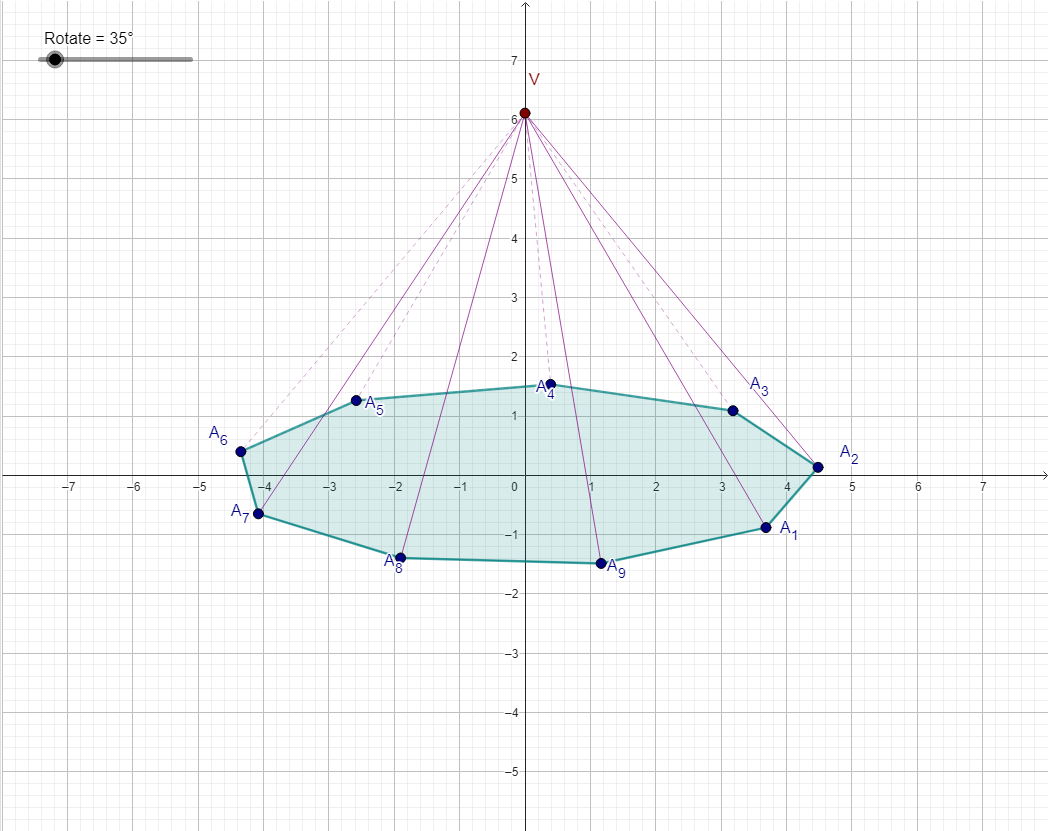
Question: draw a pyramid with a base that has a nonagon as base
A nonagonal pyramid (also known as an enneagonal pyramid) is a three-dimensional geometric polyhedron formed by connecting a 9-sided polygonal base (a nonagon) to a single point called the apex.
Key Geometric Properties
- Vertices ( ): vertices
- Faces ( ): faces
- Edges ( ): edges
Euler's characteristic formula for convex polyhedra is satisfied:
Structural Details of a Regular Nonagonal Pyramid
- Base: A regular 9-gon where each interior angle measures:
- Lateral Faces: If the apex is centered directly above the centroid of the regular base (a right pyramid), all lateral faces are congruent isosceles triangles.
- Height ( ): The perpendicular segment from the apex to the center of the base.
Use the interactive rotation slider in the diagram to inspect the structure from various viewing angles in 3D space. Dashed lines indicate edges on the back side of the perspective.