Discriminant And Roots
Question: Explain the discriminant and nature of roots
1. The Quadratic Formula and the Discriminant
For any quadratic equation in standard form:
The roots are given by the quadratic formula:
The algebraic term inside the square root determines whether the solutions are real, distinct, equal, or non-real. This term is defined as the discriminant, denoted by the Greek letter
(delta):
2. Nature of Roots and Geometric Interpretation
The roots of the equation
correspond directly to the
-intercepts of the parabola
.
| Condition | Nature of Roots | Geometric Meaning ( -intercepts) | Parabola Position ( ) |
|---|---|---|---|
| Two distinct real roots | Intersects the -axis at two distinct points | Vertex lies below the -axis | |
| One double real root (or two equal real roots) |
Touches the
-axis at exactly one point (tangent to the -axis) |
Vertex lies directly on the -axis | |
| No real roots | Does not intersect the -axis | Entire curve lies strictly above the -axis |
3. Key HKDSE Examination Keywords & Conditions
In HKDSE questions, pay close attention to the exact phrasing in the question:
-
"The equation has real roots" (Covers both distinct roots and equal roots .)
-
"The line is tangent to the curve / touches the curve" Set the two equations equal to form a single quadratic equation , then apply:
-
"The graph lies completely above the -axis" ( for all real )
-
"The graph lies completely below the -axis" ( for all real )
-
Non-zero Leading Coefficient Rule (Critical Exam Trap) If an equation contains an unknown parameter in the coefficient, such as :
- For it to be a quadratic equation with real roots: , alongside .
4. Interactive Visualizer
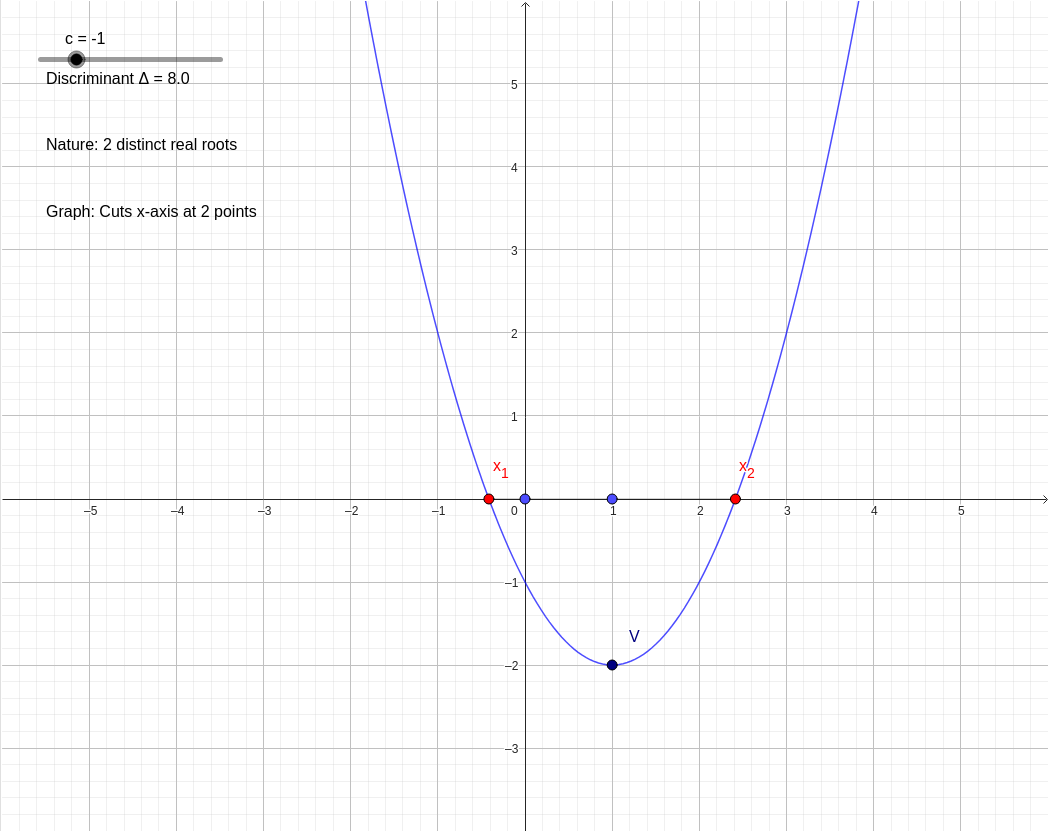
The interactive model below plots the parabola
. You can adjust the sliders for
,
, and
to observe how the sign of
governs the curve's contact with the
-axis.
• Blue Curve: Parabola y = ax^2 + bx + c
• Green / Orange / Red Text: Live value of Δ and the resulting Nature of Roots