Derivative as the Slope of the Tangent Line
Question: Can u give me a video for derivative concept
The Geometric Concept of the Derivative
The derivative of a function at a point represents the instantaneous rate of change, which corresponds geometrically to the slope of the tangent line to the curve at that point.
1. The Secant Line and Average Rate of Change
Consider a curve
and a fixed point
.
If we choose a second point
on the curve at a horizontal distance
from
:
- The horizontal change is .
- The vertical change is .
- The slope of the secant line passing through and is the average rate of change:
2. The Tangent Line as the Limiting Position
As
approaches
(
):
- The point slides along the curve toward the fixed point .
- The secant line rotates closer and closer to the tangent line at .
- In the limit where , the slope of the secant line becomes the exact slope of the tangent line:
Interactive Visual Guide
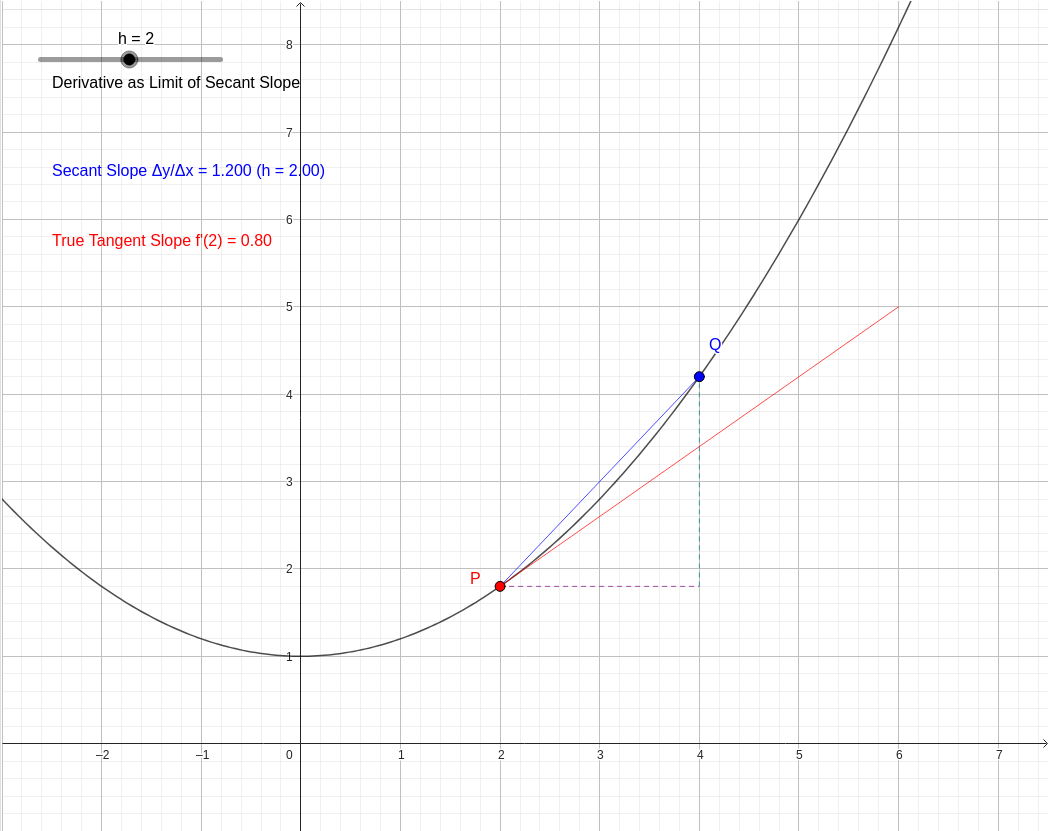
In the diagram below:
- Black Curve: Represents the function .
- Point (Red): The fixed point of tangency at .
- Point (Blue): The moving point at .
- Blue Line: The secant line passing through and .
- Red Dashed Line: The true tangent line at , having a fixed slope of .
- Slider : Drag the slider towards to watch point merge into , causing the blue secant line to coincide with the red tangent line.