Perpendicular Diagonals: Cyclic iff Triangles ABP and CDP Have Equal Area
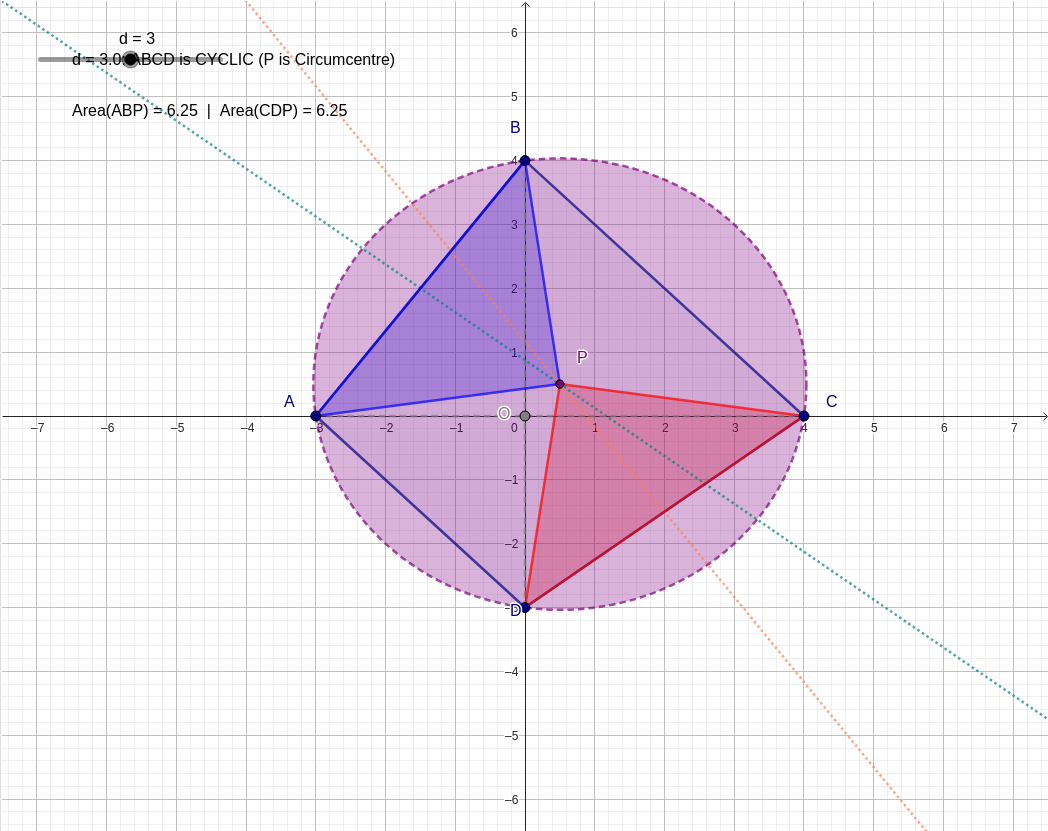
Question: Intheconvexquadrilateral ABCD, the diagonals AC and BD areperpendicular and the opposite sides AB and DC are not parallel. Suppose that the point P, where the perpendicular bisectors of AB and DC meet, is inside ABCD. Prove that ABCD is a cyclic quadrilateral if and only if the triangles ABP and CDP have equal areas.
To prove that the convex quadrilateral
is cyclic if and only if
, we use an analytic coordinate geometry approach based on the perpendicular diagonals.
1. Coordinate Setup
Let the diagonals
and
intersect at the origin
. Since
, we place:
- The diagonal along the -axis: and with .
- The diagonal along the -axis: and with .
Since
lies strictly inside the segments
and
, we have:
2. Condition for to be Cyclic
By the Intersecting Chords Theorem (Power of a Point with respect to the circumcircle),
is cyclic if and only if:
Thus,
is cyclic
.
3. Equations of the Perpendicular Bisectors
-
Perpendicular Bisector of ( ):
- Midpoint:
- Vector , so the normal vector is (or direction vector is ).
- Equation:
-
Perpendicular Bisector of ( ):
- Midpoint:
- Vector
- Equation:
The intersection of
and
is the point
. The slopes of
and
are
and
. Since
and
are not parallel,
, ensuring a unique intersection point
.
4. Expressing the Areas of and
For any point
inside the quadrilateral:
- The area of with vertices , , is:
- The area of with vertices , , is:
Subtracting the two areas gives:
Using Cramer's rule to substitute the coordinates
from the linear system:
we obtain the algebraic simplification:
5. Conclusion
- Since and , the term .
- Since , the denominator .
Therefore: