Quartic Function with a W-Shaped Graph
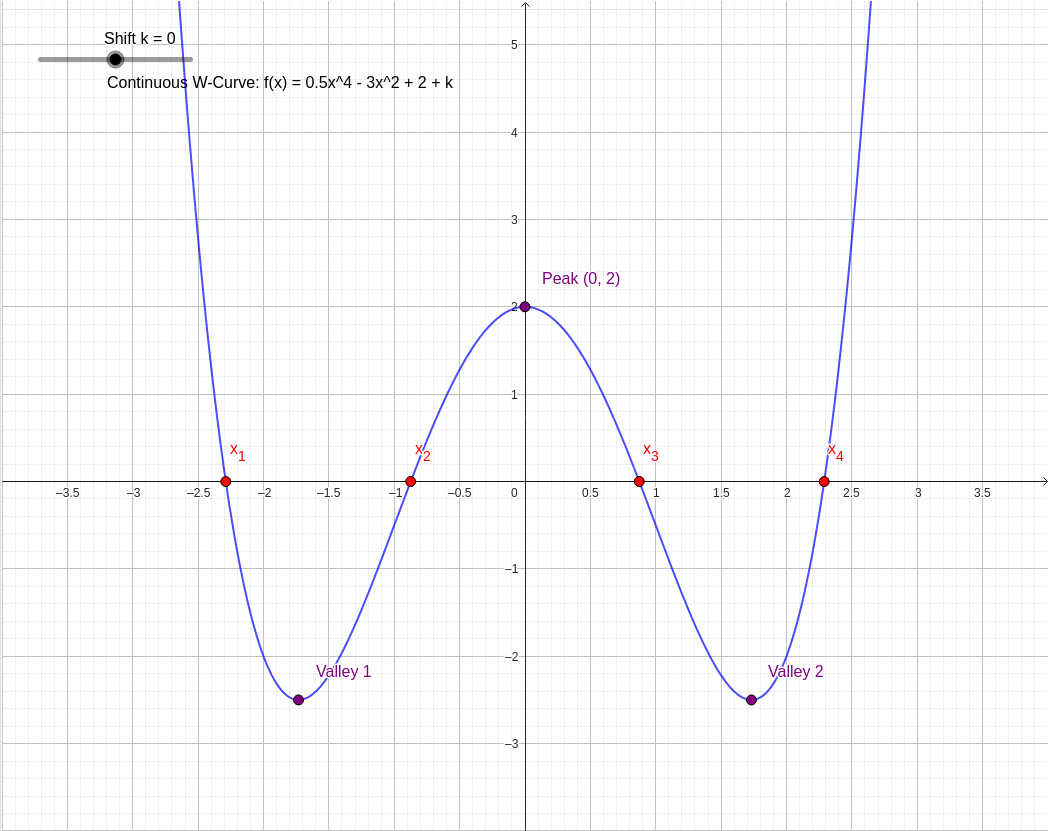
Question: create a continuous W that goes across the x axis
To create a continuous "W"-shaped curve that extends across the
-axis, we can use a quartic (degree 4) polynomial function.
Mathematical Formulation
A general symmetric quartic function of the form:
produces the characteristic "W" shape:
- End Behavior: As , the dominant term , causing both outer branches to rise upwards.
- Turning Points (Critical Points): Taking the first derivative:
This yields three stationary points:
- A local maximum (central peak) at with .
- Two local minima (bottom valleys) at with .
- Crossing the -axis: By choosing and , the central peak sits above the -axis while both valleys dip below the -axis. This ensures the curve crosses the -axis at four distinct real roots.
Specific Example
Using
:
- Central Peak:
- Valleys: and
- -intercepts: Four symmetric roots where :
The interactive diagram illustrates this continuous "W" curve with its critical points and roots clearly marked. You can also use the slider
to shift the curve vertically and observe how the intersections with the
-axis change.