Compare Binomial Poisson Distribution
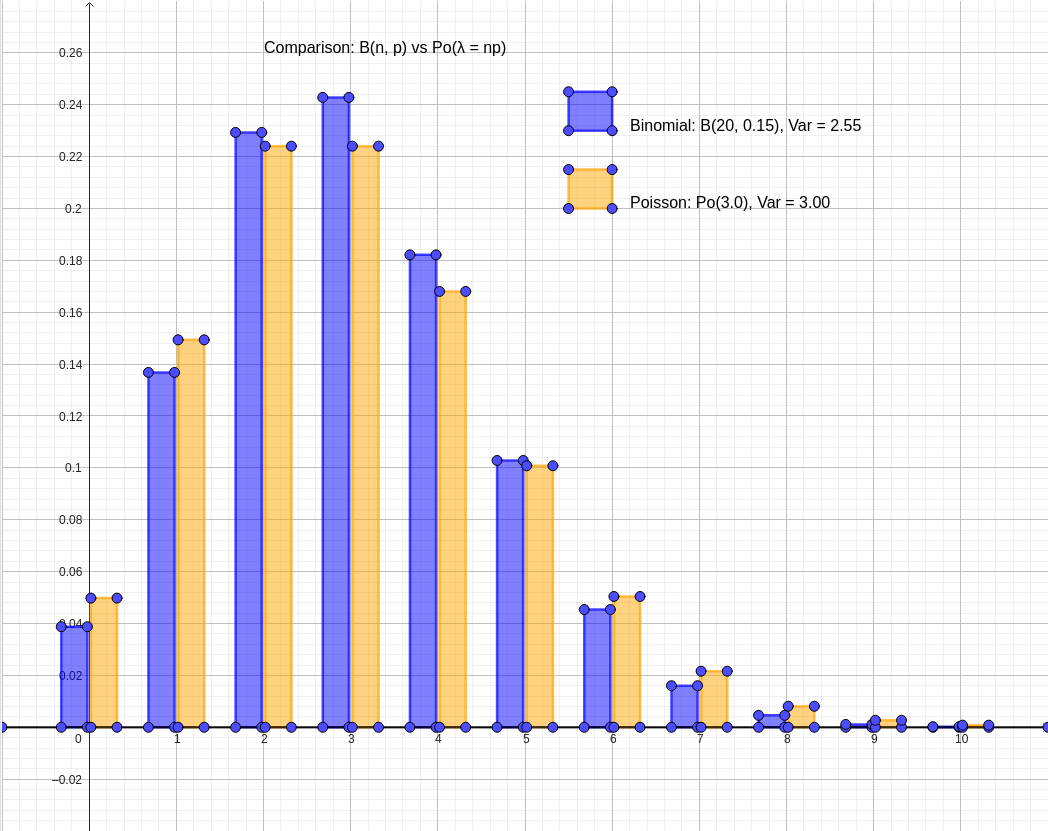
Question: Compare a binomial and a Poisson distribution
The Binomial distribution and the Poisson distribution are two fundamental discrete probability distributions in HKDSE Mathematics Module 1. While both model the count of successful events, they arise from different physical setups and have distinct mathematical properties.
1. Fundamental Characteristics
-
Binomial Distribution Models the total number of successes in a fixed number of independent trials , where each trial has the same probability of success .
-
Poisson Distribution Models the total number of occurrences of an event in a continuous interval (e.g., time, area, or volume), where events occur independently at a constant average rate .
2. Comparison Summary
-
Parameters:
- Binomial: Two parameters — (number of trials, positive integer) and (probability of success, ).
- Poisson: One single parameter — (mean rate of occurrence, ).
-
Range of Values (Support):
- Binomial: (finite, strictly bounded by ).
- Poisson: (countably infinite, unbounded).
-
Probability Mass Function (p.m.f.):
- Binomial:
- Poisson:
-
Mean and Variance:
- Binomial:
Since , the variance of a Binomial distribution is always strictly less than its mean: .- Poisson: The mean and variance of a Poisson distribution are always equal: .
3. Poisson Approximation to the Binomial Distribution
When the number of trials
is very large (
) and the probability of success
is very small (
or
), the Binomial distribution
is closely approximated by the Poisson distribution
, where:
In the accompanying diagram:
- Blue bars represent a Binomial distribution with mean and variance .
- Orange bars represent a Poisson distribution with mean and variance .
- Notice how closely matched the two distributions are around the mode, illustrating the limiting behavior connecting the two models.