Find h and k When Translated and Reflected Images Coincide
Question: The coordinates of points A and B are (2h-7,2) and (h+2,k-3) respectively.A is translated to the right by 7 units and B is reflected with respect to the x-axis.It is given that the two images obtained are coincided.
To solve for the unknowns
and
, we must analyze how the transformations affect the coordinates of points
and
. When two points "coincide," it means their resulting
-coordinates are equal and their resulting
-coordinates are equal.
1. Transformation of Point A
Point
starts at
.
A translation to the right by
units increases the
-coordinate by
, while the
-coordinate remains unchanged.
So, the image
is
.
2. Transformation of Point B
Point
starts at
.
A reflection with respect to the
-axis keeps the
-coordinate the same but negates the
-coordinate.
So, the image
is
.
3. Setting the Images to Coincide
Since
and
coincide, we equate their respective coordinates:
For the x-coordinates:
For the y-coordinates:
Thus, the values are
and
.
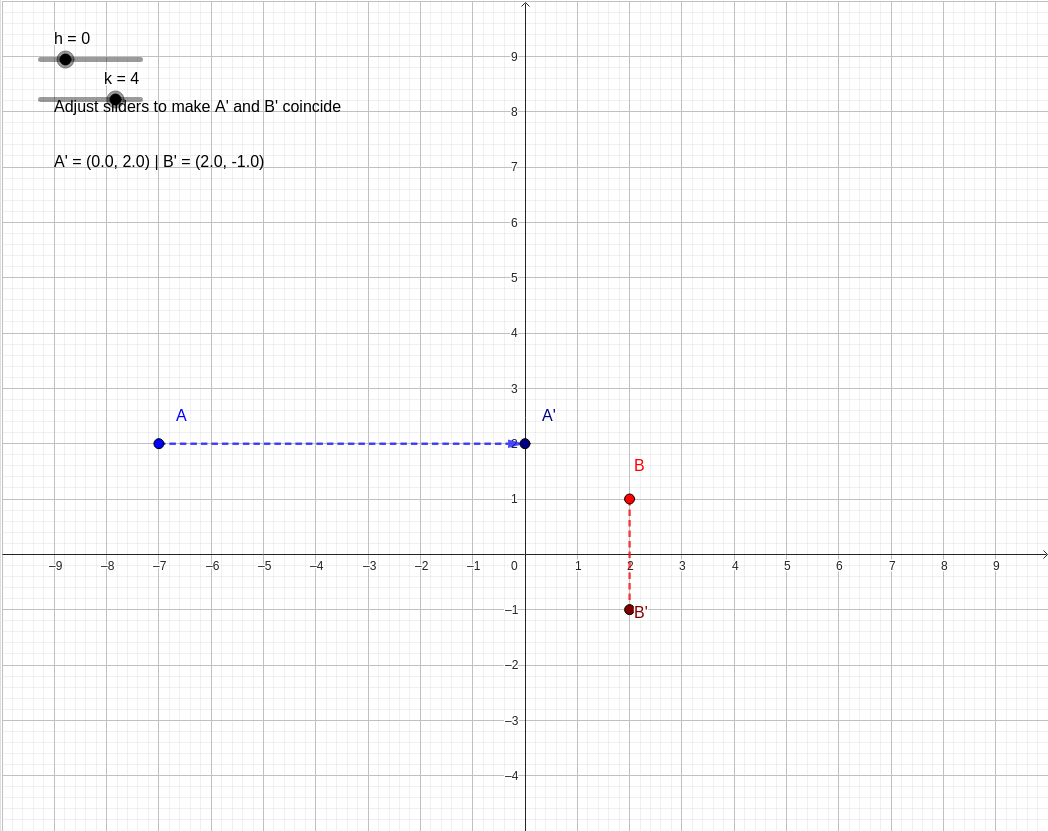
In the diagram below, you can use the sliders to adjust the values of
and
. Notice that the original points
(blue) and
(red) move as you change the variables. The dashed paths show the transformations:
translating horizontally and
reflecting vertically. The two images
and
will only overlap perfectly when
is set to
and
is set to
.