Family of Circles Through Origin with Centre on y = -x
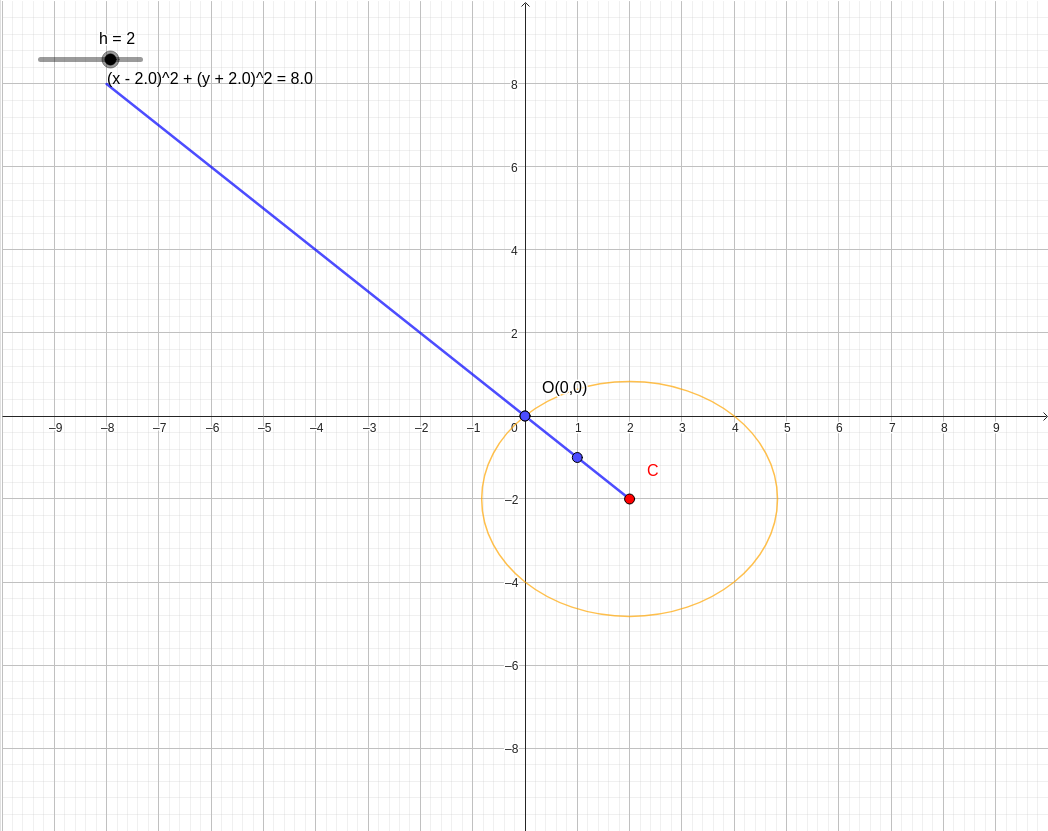
Question: 1. Circles with center on the line y=-x, and passing through the origin.
To understand the family of circles whose centers lie on the line
and which pass through the origin, we can look at the geometric and algebraic constraints:
1. The Locus of Centers
The problem states that the center of every circle in this family must lie on the line
. This line passes through the origin and has a slope of
, bisecting the second and fourth quadrants. If we denote the
-coordinate of the center as
, then the
-coordinate must be
. Thus, the center
is always at a point
.
2. The Radius
Since every circle must pass through the origin
, the radius
is defined as the distance between the center
and the origin. Using the distance formula:
3. The General Equation
Substituting the center
and the squared radius
into the standard form of a circle's equation
, we get:
Expanding this results in:
Visual Interpretation
- The Line (Blue): This is the path the centers must follow.
- The Center (Red): As you move the slider, the center travels along the diagonal line.
- The Circle (Orange): The circle dynamically resizes so that its boundary always stays anchored at the origin .
- Symmetry: Because the centers are on , the circles are symmetric about this line. Large values of create larger circles that extend into the second and fourth quadrants.
In the interactive diagram below, you can move the slider to see how the circle changes as its center slides along the line
.