Radius of Circle from Triangle BDE with B on Diameter
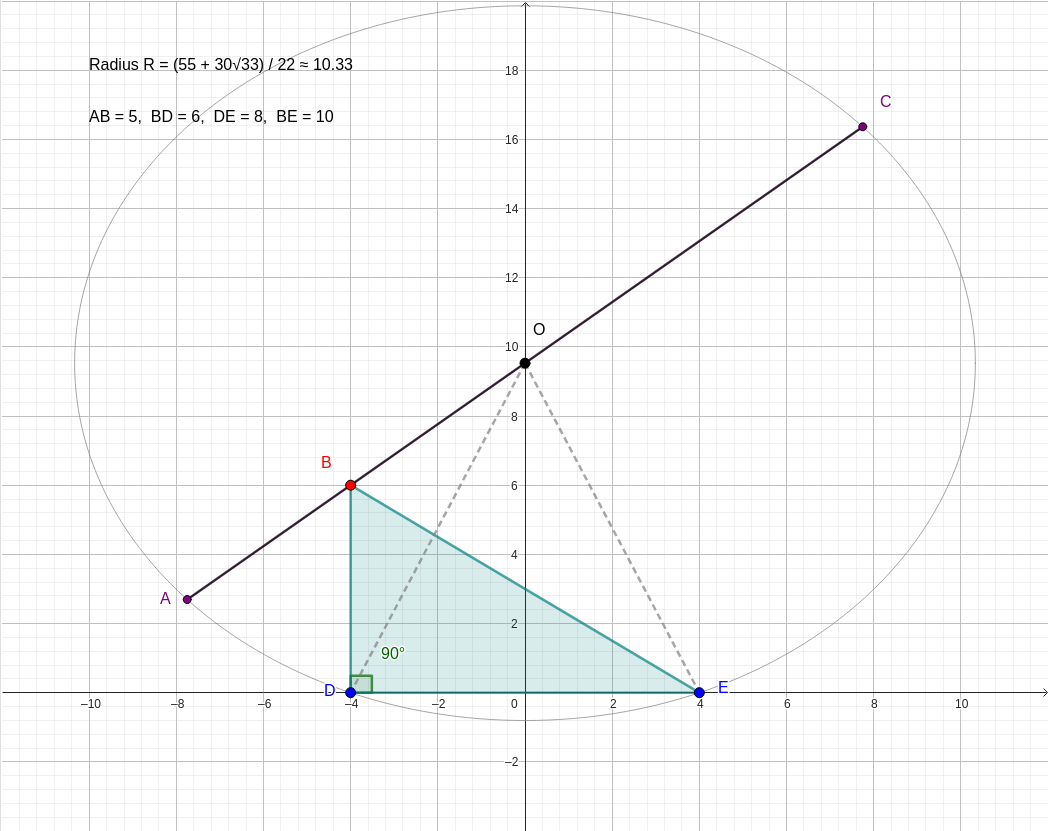
Interactive Radius of Circle from Triangle BDE with B on Diameter graph — click to explore
Click the graph to explore it interactively →
Question: In a circle, ABC is the diameter, where AB=5. Triangle BDE is a triangle such that D and E are on the circumference, and BD=6, BE=10 and DE=8. Find the radius of this circle.
To find the radius R of the circle, we use coordinate geometry and geometric properties of the circle and triangle.

1. Analyze Triangle BDE

We are given the side lengths of \triangle BDE:
  • BD = 6
  • DE = 8
  • BE = 10
Notice that: BD^2 + DE^2 = 6^2 + 8^2 = 36 + 64 = 100 = 10^2 = BE^2
By the converse of the Pythagorean theorem, \triangle BDE is a right-angled triangle with: \angle BDE = 90^\circ \implies BD \perp DE

2. Set Up a Coordinate System

Let the chord DE lie horizontally along the x-axis, with its midpoint M at the origin (0,0):
  • Since DE = 8, the midpoint gives D = (-4, 0) and E = (4, 0).
  • The perpendicular bisector of chord DE passes through the circle's center O. Thus, O lies on the y-axis: O = (0, y_O), \quad \text{where } y_O = \sqrt{R^2 - 4^2} = \sqrt{R^2 - 16}
Since BD \perp DE, the line segment BD is vertical (parallel to the y-axis):
  • The x-coordinate of B is the same as D, so x_B = -4.
  • Given BD = 6, we place B = (-4, 6).

3. Find the Distance OB

The square of the distance from the center O(0, y_O) to the point B(-4, 6) is: \begin{aligned} OB^2 &= (x_B - x_O)^2 + (y_B - y_O)^2 \\ &= (-4 - 0)^2 + \left(6 - \sqrt{R^2 - 16}\right)^2 \\ &= 16 + 36 - 12\sqrt{R^2 - 16} + (R^2 - 16) \\ &= 36 + R^2 - 12\sqrt{R^2 - 16} \end{aligned}

4. Relate OB to the Diameter AC

Since AC is a diameter of the circle, A lies on the circle ( OA = R), and B lies on the segment AC:
  • AB = 5
  • The distance from center O to B is: OB = OA - AB = R - 5
Therefore: OB^2 = (R - 5)^2 = R^2 - 10R + 25

5. Solve for the Radius R

Equating the two expressions for OB^2: \begin{aligned} 36 + R^2 - 12\sqrt{R^2 - 16} &= R^2 - 10R + 25 \\ 11 + 10R &= 12\sqrt{R^2 - 16} \end{aligned}
Squaring both sides: \begin{aligned} (10R + 11)^2 &= 144(R^2 - 16) \\ 100R^2 + 220R + 121 &= 144R^2 - 2304 \\ 44R^2 - 220R - 2425 &= 0 \end{aligned}
Applying the quadratic formula: \begin{aligned} R &= \frac{220 + \sqrt{(-220)^2 - 4(44)(-2425)}}{2(44)} \\ &= \frac{220 + \sqrt{48400 + 426800}}{88} \\ &= \frac{220 + \sqrt{475200}}{88} \\ &= \frac{220 + 120\sqrt{33}}{88} \\ &= \frac{55 + 30\sqrt{33}}{22} \approx 10.33 \end{aligned}

Final Answer

\text{Radius } R = \frac{55 + 30\sqrt{33}}{22} \approx 10.33