Circle Intersection Geometry Problem
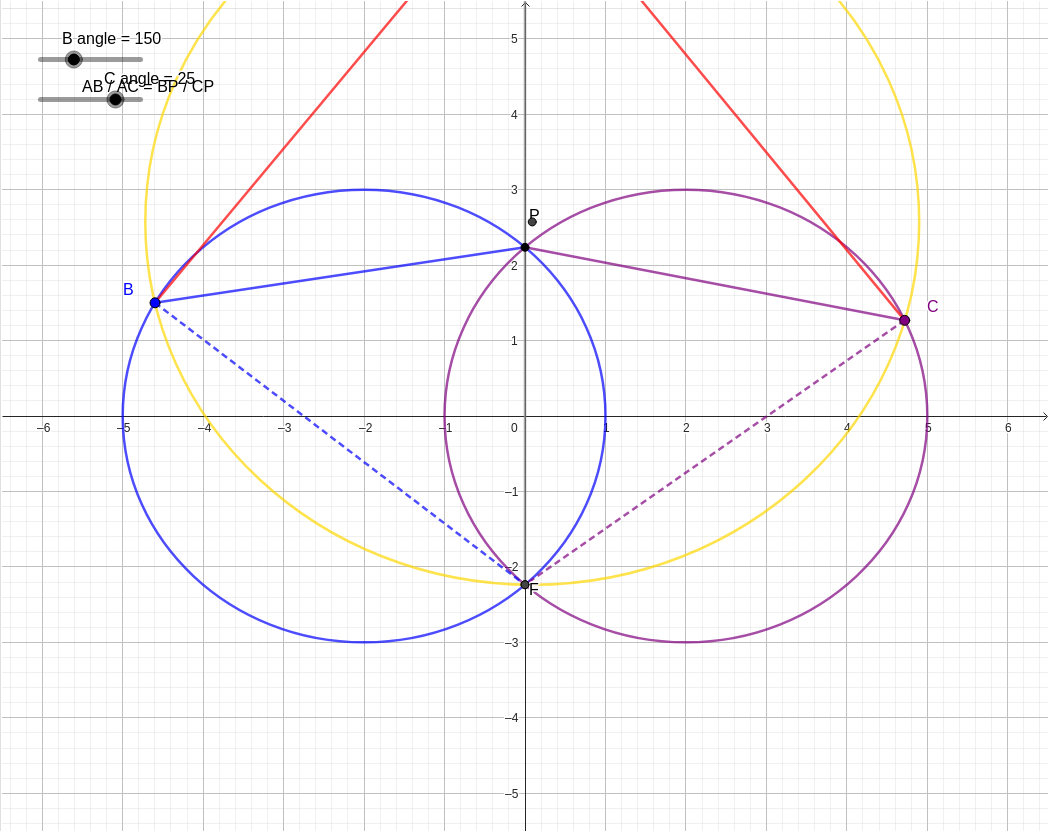
Question: Suppose P and F are the intersection of two circles of equal radii. B lies on the the first circle and C lies on the second circle such that B is outside the second circle and C is outside the first circle. Extend FP to meet the circumcircle of BFC at A. Is AB/AC= CP/BP?
To determine whether
, we can use circular inversion.
Geometric Proof via Inversion
1. Setup and Symmetry
Let
and
be the two circles of equal radius
intersecting at points
and
.
- The common chord is the radical axis of and .
- Because and have equal radii, they are reflections of each other across the line .
2. Inversion Centered at
Apply an inversion centered at
with arbitrary radius
:
- The line passes through the center of inversion , so it inverts to itself.
- Since and both pass through , they invert to two straight lines, and .
- By symmetry across , the lines and are reflections of each other across the line .
- The point inverts to , and the line acts as the angle bisector of .
- Points and invert to and .
- The circumcircle of passes through , so it inverts to the line .
- Point is the second intersection of the line with the circumcircle of , which means inverts to:
3. Applying the Angle Bisector Theorem
In
, the ray
is the angle bisector of
, with
lying on
. By the Angle Bisector Theorem:
4. Transforming Back via Distance Inversion Formula
Under inversion with center
and radius
, the distance between any two points
relates to their inverted counterparts
by:
Applying this formula to the ratios:
Since
, it immediately follows that:
Conclusion
In general,
, not
. Therefore:
- is false in general (it only holds in the trivial symmetric case where ).
Below is the interactive visual construction demonstrating this relationship.