Angle Between Line Plane
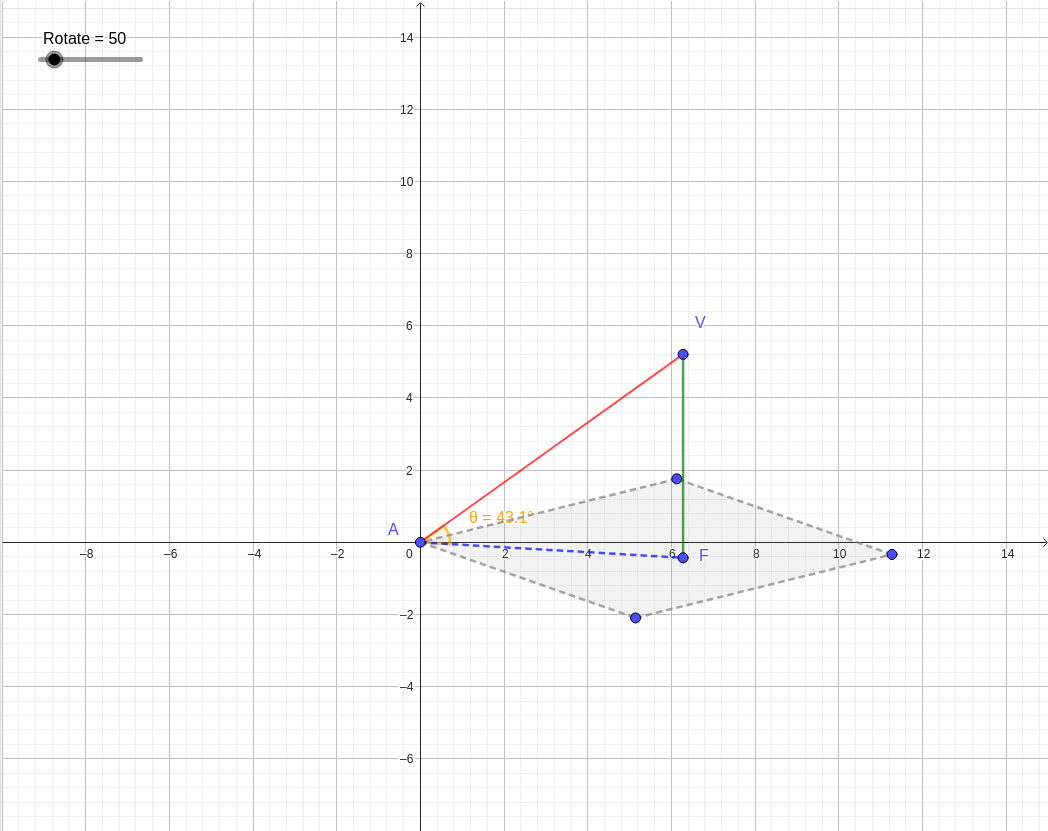
Question: Find the angle between a line and a plane
In the study of 3D trigonometry for the HKDSE, the angle between a line and a plane is defined as the angle between the line and its orthogonal projection on that plane.
To determine this angle, we follow a specific geometric construction:
- Identify the intersection: Locate the point where the line meets the plane. Let this be point .
- Pick a point on the line: Choose any point on the given line (that is not ).
- Drop a perpendicular: From point
, drop a perpendicular line to the plane. The point where this perpendicular meets the plane is called the foot of the perpendicular, denoted as
.
- Since is perpendicular to the plane, [definition of line plane].
- Form the projection: Draw the line segment . This segment is the orthogonal projection of the line on the plane.
- Identify the angle: The angle between the line and the plane is .
Example Application
Consider a line
intersecting a horizontal plane
at point
. Suppose the height of point
above the plane is
units, and the length of the line segment
is
units.
To find the angle
:
In the visual representation below:
- The grey surface represents the plane.
- The red line is the original line segment .
- The blue dashed line on the plane is the orthogonal projection .
- The green vertical line represents the perpendicular height .
- The orange arc indicates the angle between the line and the plane ( ).
Rotating the diagram will show how the "shadow" (projection) of the line always stays directly beneath it on the surface.