Angle Between Planes ADQ and BCQ in a Cuboid
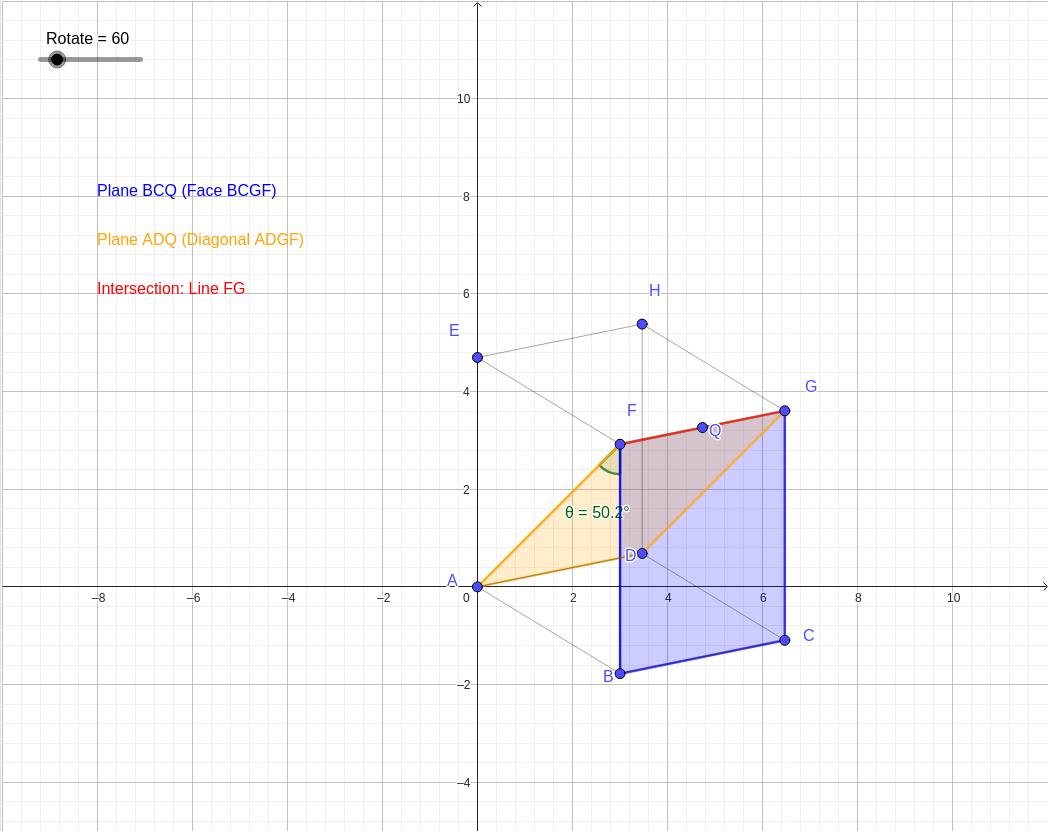
Question: ABCDEFGH is a cuboid. Q is a point lying on FG. The angle between planes ADQ and BCQ is ?
To find the angle between the planes
and
in the cuboid
, we must analyze the geometric relationships between the edges and faces.
1. Geometric Identification
In a cuboid, the following edges are parallel:
- (opposite edges of the base ).
- (opposite edges of the side face ).
- Therefore, by transitivity, .
Since point
lies on the edge
, we can describe the planes as follows:
- Plane : This plane contains the point and the line segment . Since lies on , and is in the same face as , the plane is simply the side face of the cuboid.
- Plane : This plane contains the point and the line segment . Since and is on , the line is parallel to . A plane containing a line and a point on a parallel line must contain the entire parallel line. Thus, the plane contains the entire line . This is the diagonal plane .
2. Finding the Dihedral Angle
The angle between two planes is the dihedral angle. To find it, we identify the line of intersection and then find two lines, one in each plane, that are perpendicular to that intersection line at the same point.
- Line of Intersection: Both planes contain the segment , so the line of intersection is the edge .
- Perpendicular Lines:
- In the plane (the side face), the edge is perpendicular to because the face is a rectangle.
- In the plane (the diagonal plane), the line is perpendicular to . This is because is perpendicular to the entire front face (and thus any line within it, including ).
- The Angle: The angle between the two planes is therefore .
3. Calculating the Angle
The triangle
is a right-angled triangle because the edge
(vertical) is perpendicular to the edge
(horizontal).
- The angle we are looking for is (let's call it ).
- In , we have:
The angle between the planes is the angle whose tangent is the ratio of the cuboid's length to its height (depending on the orientation of your labels).
In the diagram below, you can see the cuboid, the two planes highlighted in different colors, and the specific angle
marked at the intersection line.