Add Two Vectors
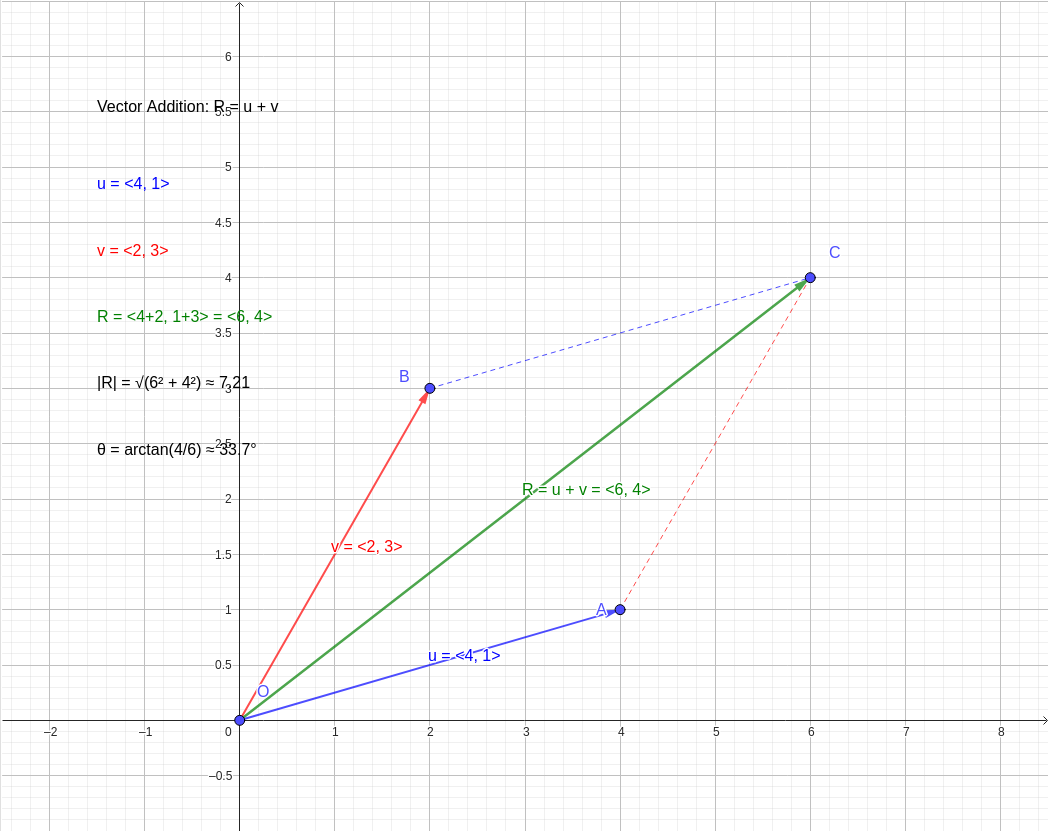
Question: Find the resultant vector by adding two vectors
To find the resultant vector
formed by adding two vectors
and
, we can use both algebraic (component) methods and geometric methods.
1. Algebraic Method (Component Addition)
Given two 2D vectors in component form:
The resultant vector
is obtained by adding their corresponding horizontal and vertical components:
Magnitude and Direction
- Magnitude (Length):
- Direction Angle (measured counter-clockwise from the positive -axis):
2. Geometric Methods
A. Head-to-Tail (Triangle) Rule
- Draw vector starting at the origin .
- Place the tail (initial point) of vector at the head (terminal point) of .
- The resultant vector is the vector drawn from the initial point of directly to the terminal point of .
B. Parallelogram Rule
- Place both vectors and such that they start at the same initial point .
- Construct a parallelogram using and as adjacent sides.
- The resultant vector is the main diagonal directed from the common initial point to the opposite vertex.
Example
Let:
Adding them together:
In the diagram below:
- Blue vector ( ) and Red vector ( ) originate from .
- The dashed lines complete the parallelogram and illustrate the head-to-tail path.
- Green vector ( ) is the resultant vector along the main diagonal.