Understanding Vectors in 3D Space
Question: i want to undertsand vectors in 3d space
A vector in three-dimensional space is a quantity that has both a magnitude (length) and a direction. While a 2D vector lives on a flat sheet of paper with
and
coordinates, a 3D vector adds a third dimension,
, which represents height or depth.
You can think of a 3D vector as an instruction for movement. If we have a vector
, it tells us:
- How far to move along the x-axis (left/right).
- How far to move along the y-axis (forward/backward).
- How far to move along the z-axis (up/down).
Visualizing the Vector Components
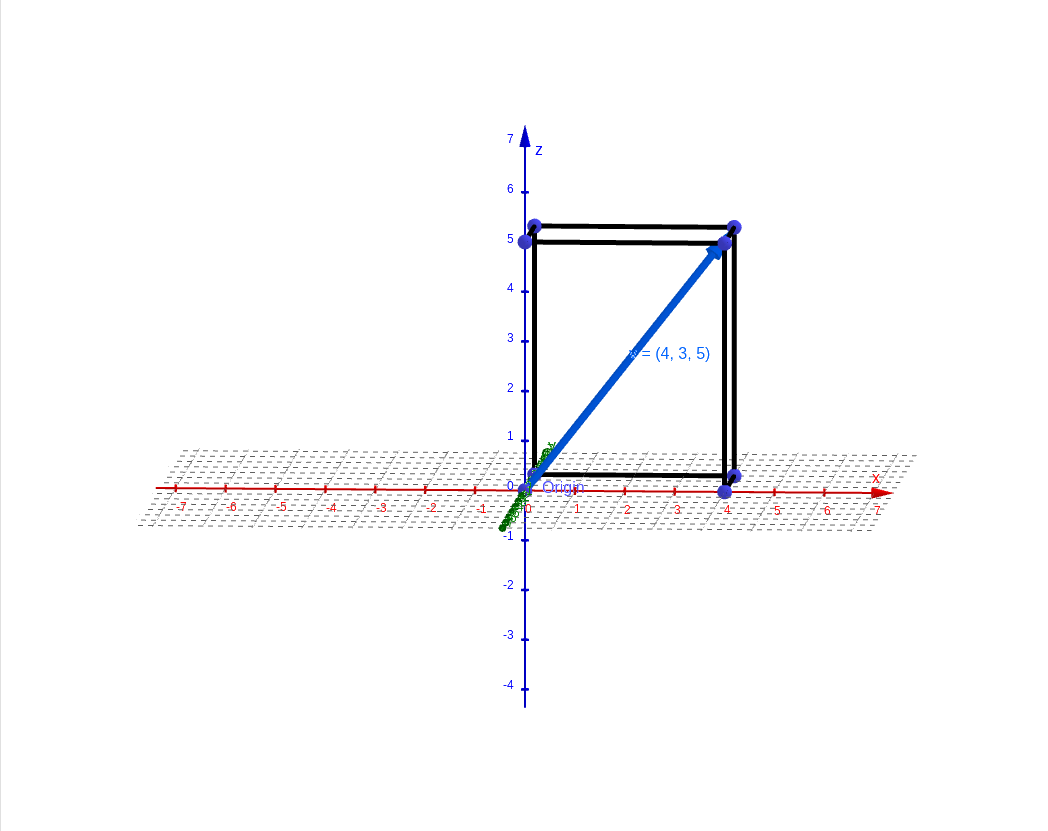
In the 3D diagram provided:
- The Blue Arrow represents the vector itself, starting at the origin and ending at a specific point in space.
- The Dashed Gray Lines form a rectangular "box" (a parallelepiped). This box helps our eyes perceive depth in a 3D view.
- The edges of this box aligned with the axes show the components of the vector. For example, the distance along the red floor axis is the -component, the green floor axis is the -component, and the vertical blue axis is the -component.
Magnitude and Direction
The length of that blue arrow is called the magnitude. In 3D, we calculate this using a 3D version of the Pythagorean theorem:
Every unique combination of
points the arrow in a different direction and gives it a different length, allowing us to describe any movement or force in the physical world.
Instruction for the 3D View
The diagram shows a vector
. You can see how it spans across the "room" created by the three axes, reaching from the corner at the origin to the opposite corner of the dashed box.
Vector components in 3D
The diagram illustrates how a vector
is constructed from its individual components along the
,
, and
axes. Note how the blue vector acts as the diagonal of the 3D box formed by these values.