Gradient Field of sin(x)cos(y): Direction of Steepest Ascent
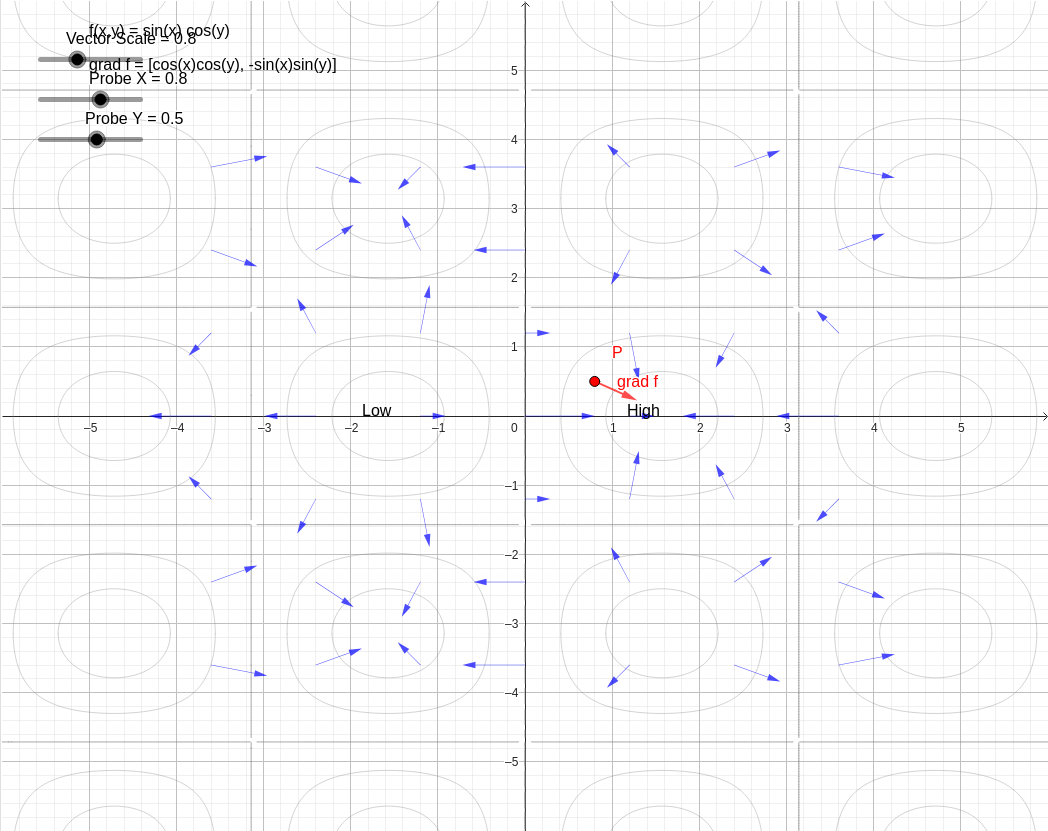
Question: Show the 2D vector field of \(f(x,y) = \sin(x) \cos(y)\) with arrows pointing in the direction of steepest ascent.
To visualize the direction of steepest ascent for the scalar field
, we use the Gradient Vector Field. The gradient, denoted by
, at any point
is a vector that points in the direction where the function increases most rapidly.
Mathematical Derivation
The gradient is defined as the vector of partial derivatives:
Visual Interpretation
In the provided diagram, you can explore how these vectors behave across the coordinate plane:
- Vector Field (Blue Arrows): These arrows represent the gradient at various points on a grid. Notice that they always point towards local "peaks" (maxima) and away from local "valleys" (minima).
- Contours (Gray Curves): These are the level curves where is constant. A fundamental property of the gradient is that it is always perpendicular to the level curves.
- Probe Point (Red): You can drag point to see the specific gradient vector at that location.
- Magnitude: The arrows are longest where the surface is steepest and shrink to a single point at critical points (maxima, minima, and saddle points), where the gradient is zero.
The function forms a periodic "checkerboard" of hills and depressions. For instance, at
, the function reaches a maximum value of
. As you move
near this point, you will see all surrounding gradient vectors pointing directly toward it.